THE VECTIS SCENERY, PART I.
COMPRISING THE MOST REMARKABLE
OF
THE ISLE OF WIGHT.
— “ Romantic Isle!
The pearl of Ocean, girdled in its foam.”
☞
The object of commencing our
Description of the Island at Cowes, is only for the purpose of an easy Reference:
as every feature of any prominency will be regularly noticed in succession, as
we are supposed to compass first the whole of the Coast – and then afterwards
(by making Newport our starting point,) visit the principal places in the
Interior.
k
TOWN
OF
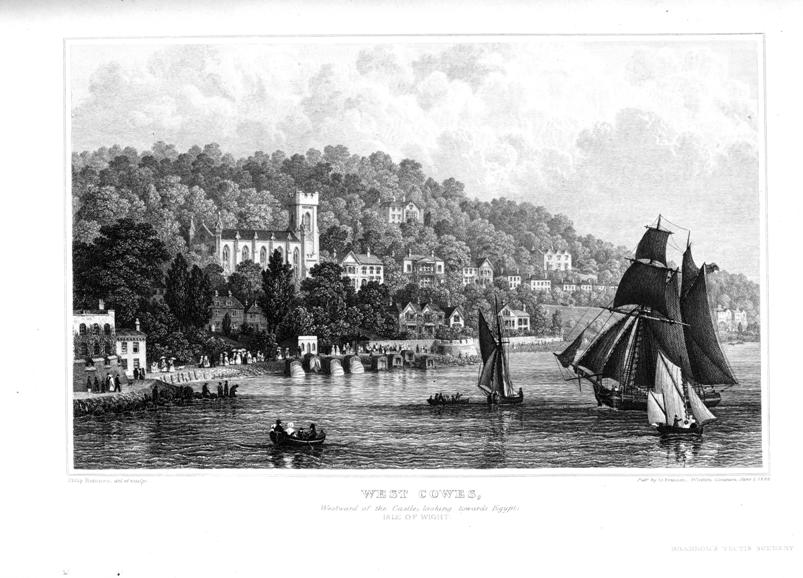
THIS is a
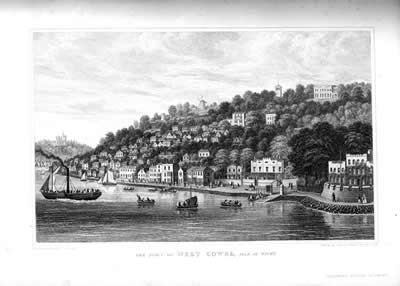
convenient, busy sea-port, as well as a fashionable watering-place, occupying
the steep slope of a hill (the most northern part of the island,) opposite the
mouth of Southampton Water, and is divided from its sister town by the Medina
(or Newport) river. Its appearance from off the water is extremely pleasing, as
the quick fall of the hill gives the advantage of the houses rising very
considerably above each other, as if they were built on a succession of
terraces, intermixed with gardens, shrubberies, and groups of magnificent
trees. We confess however that this favorable impression is almost obliterated
on our first landing from the packets: as the lower streets are both narrow and
irregular, being occupied principally by tradesmen, who of course build as near
as possible to the water's edge, not only for the sake of convenient quays, but
also for the preference given by strangers to their lodgings; but the upper
part of the town is altogether as pleasant, consisting chiefly of large, respectable
lodging-houses, many of which are sumptuously furnished, and command the most
extensive prospects.
The beach consists
of shingle or small pebbles, and having a good descent, admits of excellent
bathing in almost every state of the tide: there are several machines fully
employed, and likewise hot, tepid, and other baths for invalids.
The buildings which
chiefly attract attention at
There are two
Churches (or rather chapels of ease to the parish-church of North- wood) : the
oldest standing on the summit of the hill, screened by a grove of elms ; arid
the other westward of the castle, immediately behind the bathing-machines. The
other religious structures are...a large and handsome Roman-catholic chapel,
another for Independent-presbyterians, and one for Wesleyan-methodists.——There
are several superior inns, hotels, &c.: a Mechanics' Institution, and good
circulating-libraries and reading- rooms.
The stranger at
In the vicinity of
West Cowes are several other genteel residences: particularly WESTHILL, a
charming' cottage in the Swiss taste; the grounds are not extensive, but
beautifully shaded by several groups of fine-grown trees, and adorned with
plantations and knots of flowering shrubs: it covers the slope eastward of the
town, where the high-road branches off for Newport, and is enclosed by a
light-brick wall.
MOOR-HOUSE, distinguished by its Gothic pinnacles, is a
conspicuous object, about half a mile to the south. Near the road leading to
Gurnard Bay is WOOD-VALE,
a very picturesque subject, constructed of rough native stone, and designed in
the true rural taste : it is sequestered from the public gaze by close
plantations; but standing on the brow of a steep sloping bank, is seen to advantage
from the water—of which, and the whole of the beautiful perspective of the
opposite coast, it commands a most charming view.
F For the Names of the Proprietors or present Occupiers
of the principal Country Seats and Villas, see the List at the end of the Work.
The prospect from the whole of Cowes is extremely animating', and from the upper part almost unlimited: the source of ceaseless interest is of course the busy harbour and the Solent Channel (seen here under the form of a beautiful lake); but the opposite coast also possesses no inconsiderable share of life and beauty, particularly in the direction of the well wooded banks of Southampton Water, to the town itself.
"The white sails glide along the shore,
Red streamers on the breezes play :
The boatmen ply the dashing oar,
And wide their various
freight convey."
o
Cowes owes its origin
and rise to its excellent harbour, which admits of vessels clearing-out either
to the eastward or westward on the first offer of a fair wind: "it is
as safe as any in the British Channel, and by far the most convenient for
vessels bound to Holland and the East Countries; it is therefore much frequented
by ships to repair damages sustained at sea, and to winter in, until the season
permits them to proceed on their respective voyages."
It is also the port at which the vessels of the whole island are registered.——
Besides the old dry-dock at West Cowes, another has recently been made just
above the ferry,) of a size sufficient for the reception of the largest West
India Mail Steam-packets: and there are patent slips and private dock-yards
at both towns. In the last century
several line-of-battle ships and frigates were built at
The water which
divides the two towns, though designated a River, is in fact here an arm of the
sea about a quarter of a mile across: and indifferently called Newport or the
Medina, because a stream which rises in the south, takes a due northerly
direction through Newport to Cowes, and is in its whole course nearly in the
middle of the island. The aquatic beauty
of the valley through which it glides for the last five miles is derived from
the influx of the sea-tides : and of course the only time when strangers can
avail them- selves of a trip by water to Newport is with the flood,—returning
by the ebb, after about an hour's saunter in the town : boats regularly ply the
passage; and in favorable weather it offers really a charming excursion, though
there is nothing either of the romantic or the sublime in the character of the
scenery. The banks present a pleasing
interchange of coppice and pasturing enclosures, with cottages and very large
water-mills on and near the margin ; and as the rise of the hills on either
side is bold and lofty, the eye commands in its range a great variety of
attractive objects—churches, seats, villas, farms, and cottages, more or less
sheltered by woods and plantations : while the effect of the landscape is
greatly heightened by an interesting soft perspective : and enlivened by a
variety of trading craft and pleasure-boats taking advantage of a favorable
tide.
Various plans have
been suggested for improving
As the ROYAL
YACHT-SQUADRON make Cowes their favorite rendezvous, the general gaiety of the
place is in consequence much increased, especially about the time of their
annual meeting, which is either late in August, or early in September: for as
the members attend from every part of the United Kingdom, and as this port is
also the summer-station of the Royal Thames Yacht-Club, there is then such an
assemblage of elegant pleasure-vessels of every size and rig, from a ship of
400 tons burthen to the yawl of only 10, as forms an uncommonly brilliant and
interesting spectacle. About the same time the annual REGATTA and sailing-matches take place, during which
the town is a scene
of gaiety and bustle, being
crowded with visitants from every part of the island and neighbouring coast,
should the weather then be favorable.
o
THE TOWN OF
Has nothing in
itself particularly to call a stranger's attention : but the scenery in its im-
mediate vicinity is extremely beautiful, from the number of first-rate seats
and elegant villas by which it is adorned, and the animated character of the
surrounding prospect which the hill affords:—the luxuriance of the groves and
shrubberies is astonishing, considering the sea-breeze to which they are
exposed;—in fact, this quarter possesses a degree of amenity and cheerful
attraction quite equal to any part of the island.
From an unexpected
combination of fortunate circumstances the town is looking up to be a place of
some importance in the course of a few years : the value of property is al-
ready enhanced, and general business improved.
There are several large shipwright's yards, wharfs, marine stores,
&c.—so that at particular times there is much of the bustle of a sea-port
town : there is a spacious hotel near the water, also several good lodging-
houses; an Episcopalian chapel of ease (the parish-church being two miles off,)
and places of dissenting worship. Lately a Pier has been constructed by order
of the Trinity board for the greater accommodation of Her Majesty when landing
or embarking.
EAST COWES
PARK.——This is altogether a newly created scene, which pro- mises to be in the
course of a few years, a most splendid and imposing concentration of all that
is attractive to the opulent, the fashionable, and gay; at the same time
equally inviting to those who seek health by resorting to a mild and salubrious
locality, where they can enjoy the animating pleasure of an extensive marine prospect,
combined with botanical pursuits and the enjoyment of the best company.
The formerly open
cultivated fields between Osborne and East Cowes, comprehend- ing 160 acres,
with a rise of 170 feet above the level of the sea, have been laid-out, and are
now letting'-off in small lots for the purpose of erecting above 100 detached
mansions and villas, in every variety of style ; each to be surrounded by
ornamental shrubberies, •and so ranged that an interesting sea-view will be
afforded to all. The roads are really
beautiful, and of uncommon width, extending above two miles, and the borders
planted with timber-trees of various foliage, and a profusion of flowering
shrubs. There are several lodge-entrances: a Pier for the accommodation of the
residents; and a Hotel: but the most important feature is the botanic and
pleasure garden in the centre of the Park, measuring twenty-two acres,
and for the formation and management of which an eminent professor is engaged.
As the Plan of the
Park, and terms of letting, can be seen at almost every hotel in the island,
and procured on the spot, or in London at Messrs. Brooks and Green,
Land-agents, Old Bond-street, it releases us from the necessity of giving
further particulars ; but we cannot conclude this concise account of so
magnificent an undertaking, without heartily wishing it the success it
deserves, from the liberal spirit with which it has been conducted, and the
good taste which to us appears to be displayed throughout.
o
SEATS AND VILLAS NEAR
In proceeding up
the hill by the old carriage-road, we pass on our right the villa of Mr.
Auldjo: and on the left, Slatwoods, Spring-hill, and St. Thomas,
almost secluded from public observation by close shrubberies and groups of
stately trees: these houses are respectable structures, but characterised by no
peculiarities of design: their sites however are admirable, and possess an
unrivaled view of the very interesting picture of Cowes Harbour and the
opposite coast. About half-way up, at
the lodge-entrance to East Cowes Castle, the road divides—the right-hand branch
leading to Osborne and Newport, and the left to Norris Castle.——Of the three
first-rate seats in the neighbour- hood of East Cowes....
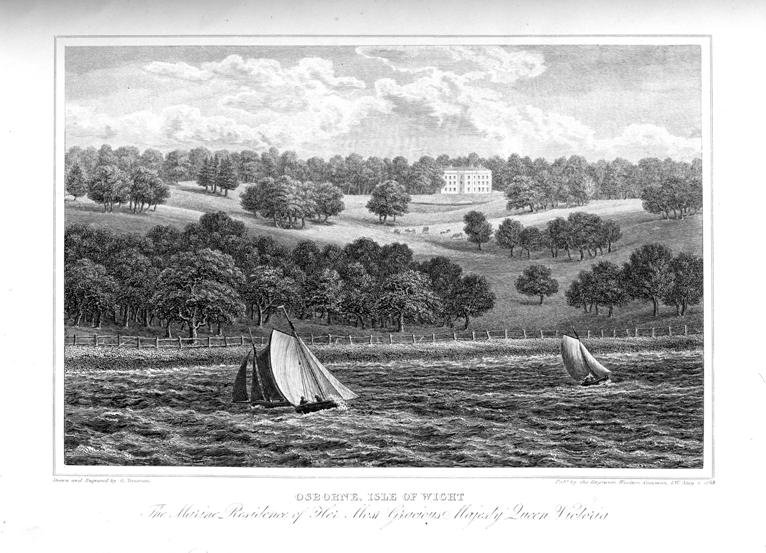
OSBORNE is now the
principal, having been purchased by Her Majesty, together with an adjoining
estate called Barton, and other contiguous cultivated property (with the
farm-houses and cottages), extending from the sea-shore on the north for about
two miles and a half in the direction of Newport, and being at least a mile and
a half in breadth; a great portion of which is now enclosed by a park-fence,
and extensive plantations already made. As was to have been expected, the
mansion and the whole of the domain are undergoing such important improvements,
as to negative any accurate description : and therefore at present we shall
only speak generally of the merits of the locality, which possesses great
capabilities of being rendered, in our humble opinion, everyway suitable for
the marine residence of a Queen of the British Isles ; and as a peculiarly
desirable situation for the younger branches of Royalty, who can here enjoy as
it were an amphibious life, without being exposed to the rude annoyance of
vulgar curiosity. To the north-east the
grounds are bounded by a charming sheltered little creek called King's Quay,
traditionally from the fact of its having afforded concealment to King John, at
the time of his division with the barons.
Very little of the
estate, and indeed nothing of the mansion except the new prospect tower, can be
seen from the highway; but in sailing up or down the Solent Channel, between
Ryde and Cowes, it appears to great advantage, being seated at the head of an
ample lawn that gently slopes to a wide and well-wooded valley open to the sea
on the north, and hence enjoys a most animating and delightful marine prospect.
This valley terminates in a beautiful pebbly beach, which admits of landing or
embarking being easily effected, except in very boisterous weather.
The fine old
mansion of BARTON was
once the residence of the lords of the manor ; for many years it was reduced to
a farm-house, and suffered to decay ; but has recently been restored by
substantial repairs, without injuring its venerable air of antiquity.
From the interest
which this residence now acquires with the public, we are prepared to expect
that many of Our readers will feel rather disappointed at the above very brief
account of the Palace of Osborne: but surely it would be worse than ridiculous
to expatiate on the character of a place that is undergoing in almost every
feature some considerable improvements : and which probably will be subjected
to many as yet unknown mutations—for one necessary alteration often obliges
another.
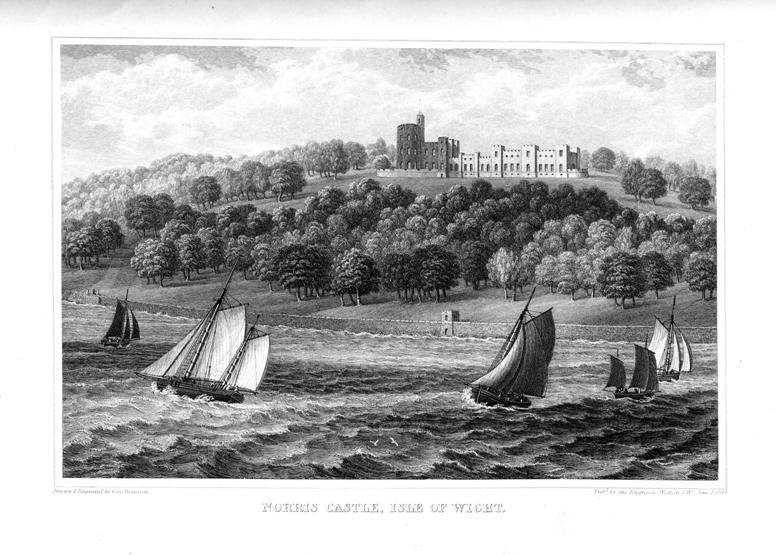
NORRIS was built in
imitation of an ancient Norman castle,—massive in its construction, and
remarkable for a stern simplicity of character disdaining all minute deco-
ration ; but exhibiting a noble general design, with the merit of a very
judicious internal arrangement: it stands upon the steep descent of the most
northern point of the island, and is a conspicuous object from every part of
the Solent Channel, the north-eastern shores of the island, and the opposite
coast. The grounds are pleasingly varied, and the plantations have now arrived
to a considerable size. The stables are on a large scale, and built in a heavy
style corresponding to the mansion, being intended for the reception of
husbandry cattle, as well as the carriages and horses of a gentleman's
establishment.
EAST COWES CASTLE
is situated nearly on the brow of the hill directly over- looking the town : is
more sheltered than Norris, and distinguished by a greater light- ness of
character,—a most pleasing diversity in the form of its several towers, and
finished throughout with a neat detail: presenting towards the cardinal points
highly picturesque fronts of varied elevations.
The style is that usually called the Moorish. The west or Conservatory front is perhaps
the most beautiful: opening upon a bowling-green terrace —and through the
graduated tints of several vistas in the luxuriant plantations, are some very
pleasing catches of the more distant objects.
The north front has also a noble aspect, and looks over the beautiful
home-picture to as delightful marine scenery as can well be imagined. The
grounds fall very favorably with gentle undulations to the water, and are
happily interspersed with some stately trees; while the pleasure-garden is en-
riched by an exquisite display of magnolias and other choice flowering shrubs,
that are rarely equalled for luxuriance of growth in the open air.
Both Norris and
"Whose verdant
meshes seem to prop the walls."
The first of these
mansions was many years in building, and scarcely more than finished at the
demise of the proprietor, the late Lord Henry Seymour (1831): subsequently it
was chosen for the summer-residence of their R.H. the Duchess of Kent and the
Princess Victoria : and in 1839 purchased on very moderate terms by R. Bell,
esq., the present proprietor. The latter mansion was also the production of a
considerable period, having received successive additions as fancy dictated, by
the late celebrated architect, John Nash, esq. (ob. 1835), who made it
his favorite residence for about forty years : it was sold by his executors to
the late Earl Shannon ; and on that nobleman's death, purchased by N. Barwell,
esq.
o
[This View gives the appearance of OSBORNE Estate at the time HER
MAJESTY purchased it. To attempt any
representation of the Mansion now erecting (or indeed even of the grounds,)
would, from its very unfinished state, be worse than useless, as giving' a deceptive
idea of what in all probability will be a most magnificent edifice. Moreover, we understand Her Majesty has
expressed herself decidedly adverse to any drawing being made of it till its
completion : and though the reader may see Views purporting to represent
"the New Palace of Osborne," we prefer, for the reasons above stated,
to defer our new view for what (judging from the rapidity with which the
building operations are carried on,) will be but a short time.]
THE TOWN OF
————
THIS delightful
watering-place is situated opposite Portsmouth, and being but little more than
five miles across, is the shortest regular passage to the island: to this
circum- stance, and the charming accommodations of the Pier, the town is
principally indebted for its progressive extension and present prosperity: not
but it possesses other attractive advantages,—such as the beauty of the
locality, and the respectability of the many families who make it their winter
as well as summer residence. About half a century back it consisted of two
distinct hamlets, with several fields and groves intervening (and thence
respectively distinguished into Upper and Lower Ryde); but such has been the
rapid and constant increase of buildings that they have long since been united
: and now completely cover the two sides of a lofty hill, on the north sloping
to the sea, and on the east falling gradually into a beautiful retiring valley.
Most of the streets are very open and well- paved, regularly disposed (crossing
at right angles), and the principal ones run parallel almost in a direct line
to the beach, thus affording the advantage of a wide and animating prospect,
especially of that constant source of interest and beauty, THE SOLENT CHANNEL, and above 40 miles of the opposite coast. The greater part of the houses are quite
modern, more or less tastefully built, and their agreeable appearance increased
by being profusely adorned with flowering shrubs intermixed with many
well-grown trees.
Ryde is extending
in every direction: and if building continue to be carried on for a few years
more with the same spirit which it has been of late, will be by much the
largest town in the island; and must prove a formidable rival to the most
fashionable watering- places in the kingdom. For religious worship there
are....three episcopal chapels of ease (Ryde being in the parish of Newchurch);
and chapels for Wesleyans, Independents, and Roman-catholics.
The lodging-houses
are very numerous, and in every variety of accommodation, from the snug cottage
at about thirty shillings per week, to the spacious mansion from 15 to 25
guineas weekly during the best part of the season. There are several Hotels and
Inns, of which the Pier—Yelf's—and the Kent are the principal: excellent
circulating-libraries reading-rooms, and a Mechanics' Institution: and a neat
little theatre. The shops are numerous, in every branch of business, and many
of them fitted-up in a very imposing style.
A most commodious
Market and Town-house was constructed a few years since at a great expense; but
many perhaps may deem it much too magnificent for the present population and
demands of the place: still, however, it proves the spirited conduct of the
inhabitants in regard to local improvements.
The ROYAL VICTORIA ARCADE is another handsome building, containing
fourteen shops, and a large exhibition-room fitted-up in a neat style,—the
whole being estimated to have cost £. 10,000.
Near the
Market-house, and just below the oldest church, is a very magnificent line of
buildings called "the Terrace," consisting of uniformly large and
elegant houses, having a beautiful lawn-like field sloping to the water in
front, adorned with several well-grown
oaks and elms. There is likewise,
on the west side of the town, a most handsome square, comprising a variety of
tastefully embellished houses : and indeed in every direction may be seen
first-rate mansions constructing—tenants being found for most of them even
before they are completed.
Formerly it was an
easy task to point out distinctly to the stranger all the principal
residences in and near Ryde : we had then only to name WESTMONT, standing on the top of the hill—RYDE HOUSE, a little to the westward—and the
unostentatious Villas of Earl Spencer and the Duke of Buckingham : but now it
would be an absurd attempt to enumerate all the attractive buildings, and at
the same time to bestow on each sufficient description to enable a stranger to
distinguish one from the other.
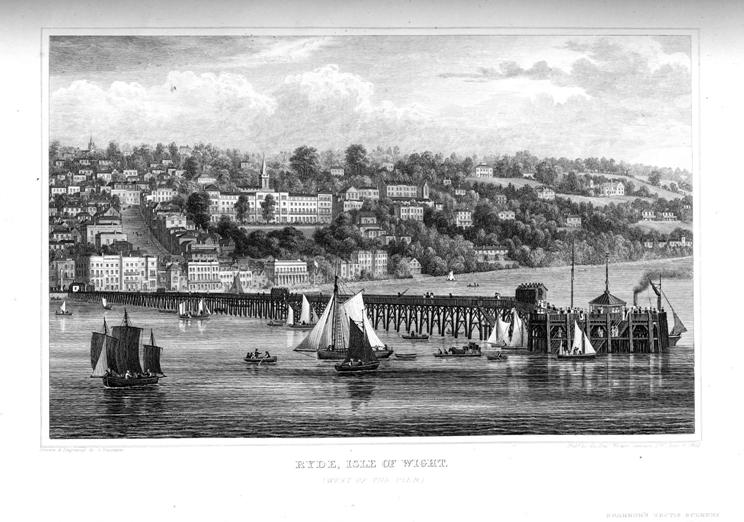
THE PIER.
This invaluable
accession to Ryde is firmly constructed of timber, and stretches out to the
uncommon length of 2240 feet, exclusive of the spacious head; thus affording a
most charming promenade, especially to convalescents who require the
invigorating sea-breeze.
It was commenced in
the year 1813, and opened in the following year, the necessary funds having
been raised by public subscription in shares of £.50 each : but it has since
been lengthened one thousand feet, vis. 500 in the year 1824, and as many more
in 1833: and in 1842 it received the splendid improvement of anew head, made
sufficiently large to admit several vessels laying alongside at the same time.
As yet it has not proved a very lucrative speculation to the shareholders
(though indispensable to the town): not having paid on an average of several
years more than 2^ or 3 per cent.
The reader will
readily appreciate the value of the Pier, in affording the most comfortable
facilities for passengers landing or embarking in all states of the tide,—when
he is told that previous to its erection, the usual custom was (ex- cept during
the very short interval of high water,) for passengers to be crammed into a
common luggage-cart, and then drawn for a considerable distance through the
waves by a horse, till it reached a depth sufficient for a boat to float
alongside, into which they were then transferred, and conveyed off to the
packet. Now this united cart and boat
process of landing or embarking certainly could not be very inviting at the
best of times : but it was really terrific to weak and timid persons during the
concurrence of a fresh gale, a heavy rain, and the tide perhaps at its lowest
ebb !— to say nothing of the horrors of a dark and squally night.
The SHORE is now covered with a thick and increasing-
layer of fine white sand, sufficiently firm to bear wheel-carriages, and which
is found to be extremely pleasant when bathing, for which there are many
well-attended machines: it has however so little des- cent, that at low water
it becomes almost an extensive flat; and after being exposed seven or eight
hours to a powerful sun in calm weather, renders the sea as it flows nearly
equal to a warm bath. As the ebbing tide leaves the sand in a perfectly firm
state for walking, a saunter on the strand eastward of the Pier is the most
delightful imaginable on a fine summer's day, if we wish "to enjoy a near
view of the waves in all their varieties breaking on the shore, or the
enchanting sound of their murmurs as they die away on the beach :" the
greater part of it is likewise beautifully fringed with overhanging woods; and
interspersed with fragments and masses of rock, some bare, and others
picturesquely enveloped in weeds.
—————"The wind was hush'd,
And to the beach, each slowly lifted wave,
Creeping with silver curl, just kiss'd the shore,
And slept in
silence."
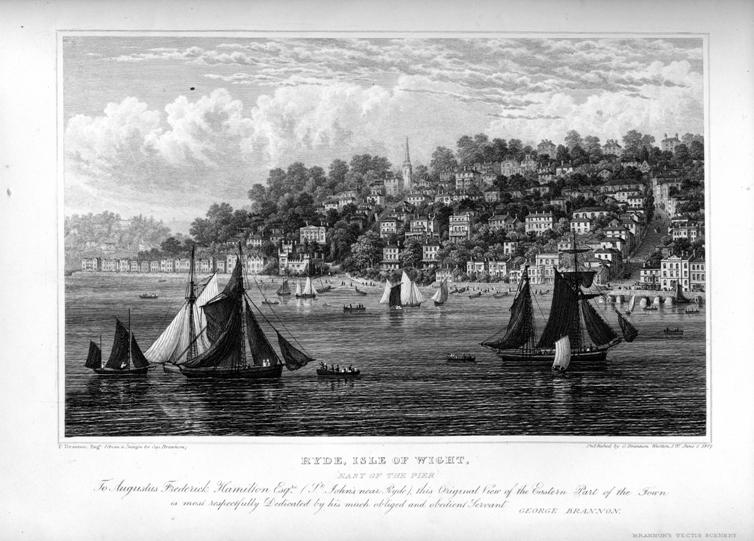
The Royal
Victoria Yacht Club, formed at
Ryde in the summer of 1845, already numbers many distinguished members, and
promises to rival any similar society in the kingdom: the vessels are of almost
every size and rig, including several large wherries (of from 20 to 30 tons
each),—a species of craft for which the local watermen have long been noted,
and which are pronounced by nautical men to be admirable sea-boats. The
Club-house is a large and handsome building, on the shore west of the Pier.
The Ryde Regatta was originally established for
the laudable purpose of giving encouragement to the skilful and deserving
watermen of the place: and now the presence of a local Yacht-club must of
course give increased variety and interest to the amusements. On these festive
occasions the Pier is in its whole length crowded with well-dressed per- sons
assembled from both town and country: which, with the gay appearance of the
numerous boats, steam-packets, and pleasure-vessels sporting about in every
direction : the grand display of colors, firing of signal guns, and the playing
of music, with the sprightly bustle of the competitors,—altogether produce a
most animated and brilliant scene.
——E——
THE ENVIRONS OF RYDE.
In the neighbourhood
of Ryde are the finest woods in the whole island, enlivened by the presence of
many gentlemen's seats which enjoy the most delightful situations : such
are....St. John's—Appley—St. Clare—Puckpool—Fairy-hill—Sea-grove—and the
Priory, to the eastward: Westmont—Ryde House—Stonepits—Brookfield—Binstead—and
Quarr, to the westward : and several others of less note, which render the
environs exceedingly pleasant: indeed the rapid increase of the town itself,
and the many tasty villas that are continually rising in its immediate
vicinity, prove how much this part of the island is admired.
Appley is a most lovely marine villa about
half a mile from Ryde, below
St. clare is another beautiful marine
villa eastward of Appley, of considerable dimensions, built in the Gothic
taste, and adorned with a neat tower: its locality is scarcely surpassed by any
of the felicitous sites along this part of the coast.
Puckpool is also a very pleasant spot
contiguous to St. Clare, distinguished by the erection of a handsome Swiss Cottage,
nothing- of which however can be seen, except on being admitted within the
grounds.
We next come to a
very cheerful village called SPRING-VALE, consisting of lodging-houses
newly-built along the beach.
Less than half a
mile further is another well-situated hamlet on the shore called SEA-VIEW,
where nearly every cottage is furnished for lodgings. Close by are two delightful villas : FAIRY-HILL, a respectable brick mansion on a commanding
site ; the ground falling in varied slopes to the sea, finely interspersed with
trees :—and on the east side of the lane is another equally charming, and very
appropriately called SEA-GROVE.
THE PRIORY is three
miles from Ryde. This beautiful domain
takes its name from having been the site of a cell to an abbey in
BINSTEAD, about a
mile westward of Ryde, affords a very delightful walk across the fields. We
pass on our left, STONEPITS and BROOKFIELD
Cottages, the new Parson- age, and several other tasty genteel dwellings: and
on the right, the parish-church (lately rebuilt). To the north and west of the cemetery are
the rural cottages of J. Fleming, esq., standing in the midst of grounds long
celebrated for their picturesque beauty. Our walk may be extended with much
pleasure by following- the gravel-path through the woods to QUARR....
" Whose mouldering abbey-walls o'erhang the glade,
And oaks coeval spread
a mournful shade."
THE PROSPECT from Ryde
and its vicinity.——As the amenity of every situation much depends upon the
range and beauty of the View which it commands, we here give a faint sketch of
that obtained from this quarter of the island,—allowing of course greater
amplitude to those houses which enjoy the higher sites: by which, however
imperfect, it will be seen that few prospects in England can surpass this,
perhaps even in point of pleasing composition,—but certainly not as a
perpetual source of the most agreeable observation.
The foreground of
the Pier generally presents a most animated picture,—crowded with promenading
fashionables, and surrounded by numerous wherries, steam-packets, and other
craft, at anchor or gaily sailing about; a busy scene which forms a striking
contrast to the quiet sylvan charms of the home-coast from Puckpool to Osborne
and Norris Point, embellished by several delightful seats and villas. We have the Solent Channel, seen from here
to peculiar advantage,—on the one hand contracting to the appearance of a noble
river and on the other expanding and uniting with the open sea. The far-famed anchorage of Spithead occupies
the centre, with St. Helen's to the eastward for ships of war: and westward,
the Motherbank and Stoke's Bay, for merchantmen and colliers; every day
increasing or diminishing in number, and hourly altering their position with
the changing tides. On the opposite
nearest shore, contiguous to Monkton Fort, is a splendid range of houses called
Anglesea Villa; close behind, the immense mass of brick buildings that form the
grand naval hospital of Haslar, with the town of Gosport in the rear; opposite
which are the celebrated fortifications of Portsmouth, with its noble harbour
affording calm security to the maritime glory of England: Southsea Castle
stands a little to the eastward, and beyond that is the low level of Hayling
Island.
The line of
Portsdown Hills, on one of which is Nelson's monumental pillar, usually bounds
the view to the north ; but in clear weathet our range of perspective embraces
a portion of the South Downs which is crossed by the London road near
Petersfield ; and on the left the beautiful retiring banks of Southampton Water
to the town itself, backed by the woodland heights of New Forest—while to the
right it ex- tends to the spire of Chichester Cathedral; and with the aid of a
glass even to the azure promontory of Beachy Head.
From Ryde to St. Helen's and Bembridge.
The reader having
been conducted along the shore as far as the Priory, we shall now take
him by the high-road to St. Helen's, Bembridge, &c.
Immediately on
leaving Ryde we descend into a narrow valley, and then mount the lull on which
stands St. John’s (passing on our right a hamlet called OAK-FIELD); the road making several sudden turnings
under the shade of various lofty trees—of which the silver fir is so remarkably
handsome as to call for general admiration, peering from 20 to 30 feet above
the rest.——The road here divides; the branch on our right leading direct to
Brading.
Looking towards the
sea, the
ST. HELEN's GREEN.
This is a populous
village about four miles east of Ryde, composed of cottages standing
principally round a large verdant square.
The only remarkable object is the old Tower of the original
parish-church, which stands upon the beach, still struggling against the
further encroachments of the sea : which, it appears, had so far advanced upon
the cemetery in the beginning of the last century, as to oblige the inhabitants
to build another place of worship in a more secure situation, which we passed
on the road from Ryde. The old tower has the addition of a very high facing of
brick-work, which is painted white, and is preserved for the purpose of a
land-mark to ships entering the roadsted.
FShould the weather prove unfavorable for going
over to Bembridge, or the party change their determination as to the route,
they can run from St. Helen's by a good road to Eroding, and thence proceed to
Shanklin, &c. The Cliffs of
Bembridge, being the scenery which particularly claims attention, offer to
parties staying at Ryde an excellent day's trip, especially if they decline
going to Freshwater.
Extends three miles
by about one broad; and previous to the year 1830, few spots in the kingdom
could have been more congenial to the lovers of quiet seclusion, for it was
rarely visited by tourists in consequence of there being no regular horse-boat
passage across the mouth of Brading haven.
But though sequestered, it was far from being a dull situation,. as it
enjoys the most enlivened and extensive marine prospects, as well as landscape
scenery of an extremely cheerful and picturesque description.
THE VILLAGE of Bembridge at the time alluded to, was
inhabited principally by pilots and their families: when, on a sudden, an
impetus was given to building, through the active and judicious exertions of a
resident gentleman possessed of considerable landed property. To supply the
desideratum of a regular passage by a good horse-boat as well as by ferry, was
among the first means adopted to raise the place from its obscurity ; very
convenient roads were laid-out and the old ones improved :. land disposed of on
eligible terms; a quantity of trees and shrubs planted about; a large hotel
built; and in a short time, by the aid of a public subscription, the
inhabitants had the important advantage of a commodious church. In short, it has risen to the rank of a
pretty little town: the lodging-houses are of all grades; and several most
respectable families have given it the preference for their occasional or
permanent residence, notwithstanding the many attractive places throughout the
island that have recently been converted for building speculations.
It has already been
mentioned, that a range of chalk hills stretch from east to west the whole
length of the island,—the termination on the east being known by the general
designation of THE CULVER CLIFFS,* at Bembridge; while the Freshwater cliffs
and the Needle Rocks form the western boundary. It is remarkable, that at both
points the scenery is very similar: the chalky precipices soaring to a sublime
elevation, the inclination dipping north, and accompanied by a beautiful
display of variously colored earth and sand in vertical strata.
WHITE-CLIFF BAY† (distant about two miles from the ferry,) is
recommended to the attention of the tourist, as affording a fair specimen of
this sublime description of scenery, and which can be very conveniently
visited. The noble range of cliffs which extend towards Sandown are
certainly the most interesting ; but these can be visited safely only in a
boat: it is highly dangerous for any party to attempt proceeding far on a rocky
shore, unless they be certain that the tide is not more than about
ha1f-ebb.||
In the face of the cliffs looking towards Shanklin, there is a small cavern
about thirty feet below the top, called the HERMIT'S HOLE.
*"Thev are called
CULVER from the Saxon Culppe, a pigeon ; and the number of those birds
that harbour there well entitle it to the name of the Pigeon cliff." They were likewise famous in the time of
Queen Elizabeth for a particular breed of hawks.
† If the reader be
familiar with the tract of "the Negro Servant," written by the
late Rev. LEGH RICHMOND, this spot will afford him additional
pleasure: for it was here that he unexpectedly met with his young convert to
Christianity reading his Bible—a circumstance which is very affectingly
described.——See Brannon's Edition of the rev. gentleman's Description of the
Isle of Wight.
|| An instance of the
danger of a heedless saunter under these precipices occurred a few years ago,
tea family consisting of a lady, her four daughters, and a maid-servant. They were lodging at the time at Shanklin ;
and were extremely fond of taking exercise on the sands. On one occasion, they were led by their admiration
of the coast to extend their morning-walk as far as the chalk-cliffs beyond
Sandown: and it being low water at the time, had proceeded a considerable
distance before they noticed the warning to retreat— the tide had for some
time begun to flow! Alarmed at
their dangerous situation, they made the utmost exertions to escape ; but their
progress over the rocks could be but slow: the water was rapidly gaining on
them,—and they must inevitably have perished, had it not been for the
providential circumstance of their having been descried by some fishermen in
the bay, who instantly hastened to their relief.
Before we take our
leave of the Peninsula of Bembridge, we will extract from a well- known author
the following minute and beautiful description of the prospect which is gained
from the summit of the down stretching towards Yaverland :—
" The road that I
took lay over a lofty down or hill, which commands a prospect of scenery seldom
equalled for beauty and magnificence. On the left, extended a beautiful tract
of land, intersected by a large arm of the sea, which at high water forms a
broad lake or haven.* Woods, villages, cottages, and churches, surrounded it in
most pleasing variety of prospect.
Beyond this lay a large fleet of ships of war, and not far from it
another of merchantmen, both safe at anchor, and covering a tract of several
miles in extent. Beyond this again, I saw the fortifications, dock-yards, and
extensive edifices of a large sea-port town.——On my right-hand, to the south
and south-east, the unbounded ocean displayed its mighty waves, covered with
vessels of every size, sailing in all directions. To the south-west, extended a beautiful
semi-circular bay of nine or ten miles in circumference, bounded by high cliffs
of white, red, and brown colored earths. Beyond this lay a range of hills,
whose tops are often buried in cloudy mists, but which now appeared clear and
distinct. This chain of hills, meeting
with another from the north, bounds a large fruitful vale, whose fields, now
ripe for harvest, proclaimed the goodness of God in the rich provision which He
makes for the sons of men.——The whole scene, in every direction, was grand and
impressive."——REV.
L. RICHMOND.
Is a small
borough-town, very agreeably situated about four miles S.E. from Ryde, and
surrounded by the park and extensive woods of Nunwell: it comprises little more
than one long village-street, containing two inns, some good shops, and a few
respectable lodging-houses.
The church is the
oldest in the island, dating its erection in the beginning of the eighth
century: the interior marks its antiquity; and the monuments which it contains
to the memory of Sir William and Sir John Oglander, whose figures are carved in
wood, together with the various ancient inscriptions on the brass tablets and
tomb-stones, are well worth seeing; and will prove highly interesting to those
who are versed in the ancient , styles of orthography and writing.
"On digging some
graves in that part of the church called the minster, which had been the
receptacle of the dead before the spread of Christianity, and also in the
church-yard, skeletons of enormous size have been discovered. It has reasonably
been conjectured, they were the remains of ancient Saxons, and that policy led
the Christian missionaries to fix on the ground held sacred by their heathen
hearers, for the erection of a building consecrated to the worship of the
cross." Some pleasing views of
the country and haven are presented from the church-yard: and if the tourist
feel any interest in the examination of tomb-stone inscriptions, he will here
find several very well written; for example:
ON MRS. ANN BERRY.
Forgive, blest shade! The
tributary tear
That mourns thy absence from
a world like this
Forgive the wish that would
have kept thee here
And staid thy progress to
the seats of bliss
No more confined to
grov'ling scenes of night
No more a tenant pent in
mortal clay,—
Now should we rather hail
thy glorious flight,
And trace thy journey to the
realms of day."
To
the Memory of "LITTLE JANE”
Ye who delight the
pow'r of GOD to trace,,
And mark with joy each
monument of grace,
Tread lightly o'er this
grave, as ye explore
"The short and
simple Annals of the Poor."
A Child reposes underneath this sod,
A Child to mem'ry dear, and dear to GOD ;
Rejoice ! yet shed the sympathetic tear,
Jane, " the Young Cottager," lies buried here.
BRADING HAVEN,
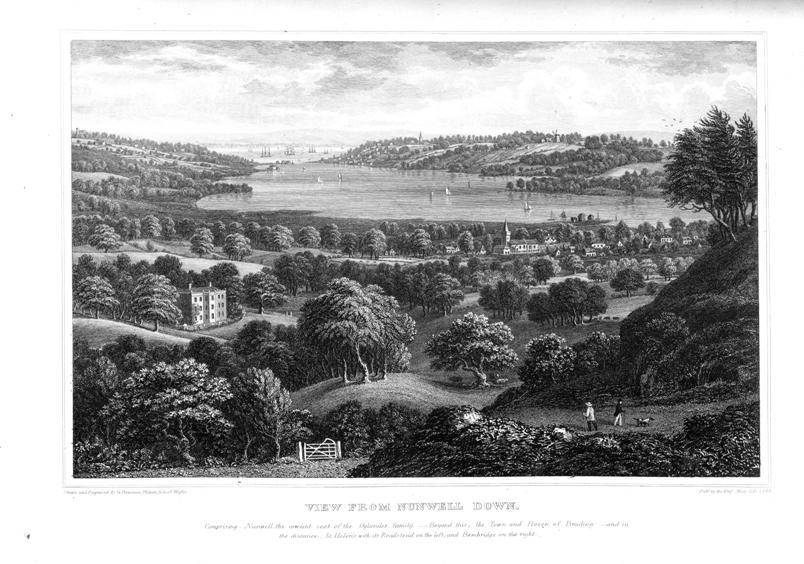
which at high water appears a beautiful lake, contains upwards of 800 acres of
sand and oozy ground, covered every tide by the sea, which enters through a
narrow inlet at St. Helen's, near Duver Point.
The hope of
recovering- so valuable a tract of land, gave birth to several unsuccessful
attempts. The famous Sir Hugh Middleton
(projector of the New River to London,) once engaged in the undertaking, and
succeeded for a short time, by means of a bank of peculiar construction: but
the sea brought up so much ooze, sand, and weeds, as to choke up the passage
for the discharge of the fresh water, which accumulating in a wet season and a
high spring-tide, the waters met, and made an irreparable breach. Thus ended an
expensive project, which cost altogether about £.7000. And after all, the
nature of the ground did not answer the expectations of the speculators: for
though that part adjoining Brading proved tolerably good, nearly one-half of it
was found to be a light running sand : nevertheless an incontestible evidence
appeared, in the discovery of a well cased with stone, near the middle
of the haven, that it had formerly been in a very different state; though
neither history nor tradition records the period when so extraordinary a change
must have taken place.
Half a mile from
Brading is NUNWELL, the seat of Sir William Oglander, bart., whose ancestors
came over from
—^,—
YAVERLAND is a
small village, one mile from Brading, and three from Bembridge ferry. The
little parish-church is of considerable antiquity, having been built in the
13th century, and still retains many perfect pieces of its original
architecture: being almost lost in an over-arching grove of magnificent elms,
it forms a very pretty composition with an adjoining farm-house, which is a
large and respectable ancient building. About a quarter of a mile further
appears the Parsonage, built in the Gothic style, and seated on a small
elevated lawn, and certainly nothing can be at once more chaste and appropriate
for a clerical residence. We next pass...
SANDOWN FORT, a
low, quadrangular fortification, flanked with a bastion at each angle, and
surrounded with a wet fosse: in time of war it was well manned, and is still
kept in repair: being the only fortress in the island at all likely to be
useful as a military post. The
complexion of the country and the character of the views now begin to change,
every tree and shrub showing symptoms of their exposure to a sea-breeze: here
we have before us a noble bay, formed by a bold sweep of shore of six or eight
miles extent, terminated to the east of Shanklin by the towering precipices of
Dunnose, and to the north by the white Culver Cliffs.
The
—<>-<>-<>—
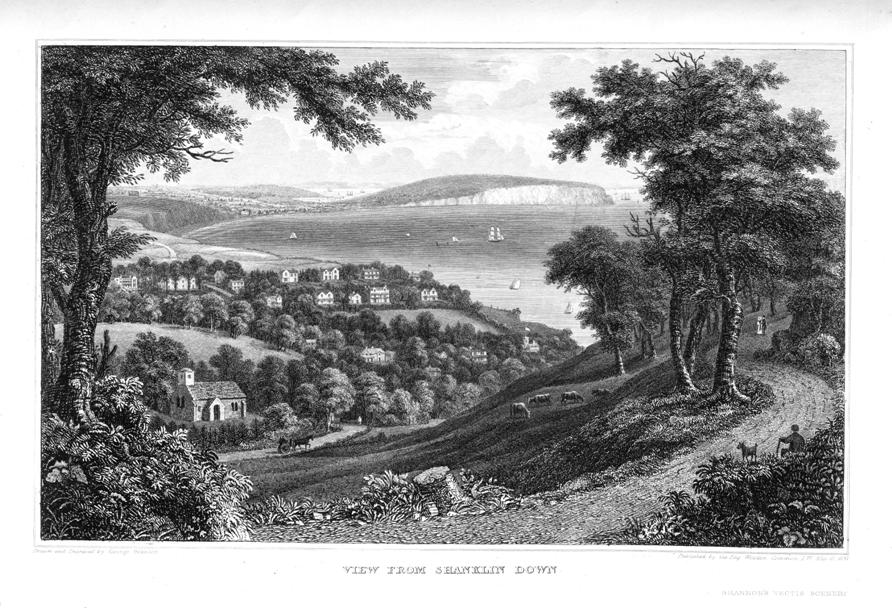
SHANKLIN.
THIS village ranks
with the most favored spots of the island, equally for its happy locality and a
romantic CHINE; and being seated in the bosom of a fertile valley opening to
the sea, but at an elevation of nearly 300 feet, it enjoys the additional
advantage of a very animated marine prospect.
The steep slopes of the hills by which it is almost surrounded, are
beautifully checquered with copse-wood and hanging groves; while pasturage and
cultivation extend their cheerful influence throughout the valley. Every
cottage however humble, has either the ornament of some noble group of trees,
or is embellished with a profusion of fragrant shrubs and flowers. The cliffs of the shore too are particularly
interesting, consisting of sublime precipices of variegated sandrock that
extend for several miles: and the beach is principally of a dark firm sand,
interspersed with masses of rock, extremely pleasant for recreation, either
walking or riding.
With such united
attractions for the enjoyment of rural life and occasional retirement, it was
to be expected that the prevailing taste for summer rustication would soon lead
to the increase both of genteel lodging-houses and private residences. Such has
proved the case, and has also led to the establishment of a second Hotel: an
entirely new hamlet called GATTEN has likewise sprung up at the north entrance to the village :-—but as
we presume -; that the object of a stranger's visit to Shanklin is to see the
natural beauties of the place, it would be trifling to detain him longer with a
Directory account of the several houses.
The proper road to
the chine is half-way down the hill as we enter the village from Ryde. We soon
reach the sea-cliffs; and turning suddenly on our right, pass under the arms of
a fine old oak which overshadows the public-house; and then wind our way down
to the beach. Here also are several new
houses, built principally for summer-lodgings, rather romantically seated at
the foot of the threatening precipice, and washed by the spray of the sea. We
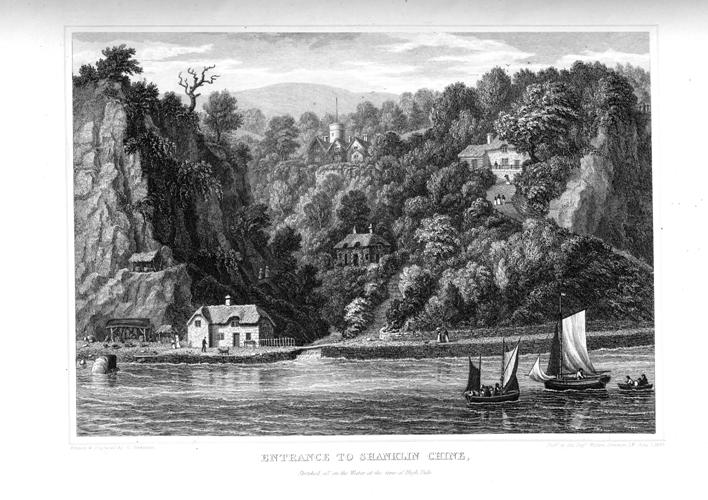
soon come to THE CHINE, at the entrance to which stands the cottage of the old
fisherman who had for many years the privilege of showing the place, as a
compensation for his trouble in keeping it accessible to visitors by means of
convenient paths.
The first view of
the chine from the beach is much less striking than that which will be afforded
from a higher point as we advance. We particularly make this remark, be- cause
many parties heedlessly hurry on without pausing for one moment to gaze on the
splendid scene which is presented on their turning to the View looking
outwards. The chasm here is at its
greatest dimensions: being about 100 yards wide at the top, and 70 or 80 in
perpendicular height, more or less abruptly contracting to the bed of the
stream. On the west side are suspended about midway two very picturesque
cottages on narrow ledges of the steep slope: while a third, of a much more
imposing figure, stands boldly on the very brink of the cliff. Both banks are thickly tufted with underwood
and orchard, with here and there a patch of vegetable-garden. From this
agreeable foreground the eye should turn to embrace in its scope the distant
objects—the broad sandy beach, enlivened by busy fishermen and groups of
pleasure-parties enjoying the refreshing breeze : the beautiful bay and village
of Sandown ; the lofty Culver Cliffs, rearing their dazzling white heads from
the bosom of the blue waters in a most sublime manner; and the very pleasing perspective
of the opposite line of coast, fading away in the azure of the South Downs :
the interest increased by the ships of war, merchantmen, and fleets of
fishing-boats that are constantly seen gliding by—nearing or vanishing on the
horizon of the sea.
We soon exchange
this animated scene for a sequestered dell, alike pleasing to the painter or
the poet. The parent rill musically
ripples in its rocky course at our feet: and we hear the softened murmuring of THE CASCADE, as yet unseen. All prospect is excluded. On
the one side is a succession of broken slopes, planted with a great variety of
of trees, and crowned by a portion of the cliff of the most glowing hues:—on
the other a murky precipice rears itself perpendicularly to a great height;
having but little vegetation to relieve its frowning aspect, except indeed the
highly picturesque accompaniments of some withering oaks and hazels still
struggling for a slender hold on its wasting brow— their contorted naked roots
and mossy spray projecting far over the abyss: and the br^rs and numerous other
wild runners that fall in long streamers, waved by the gentlest breath of air.
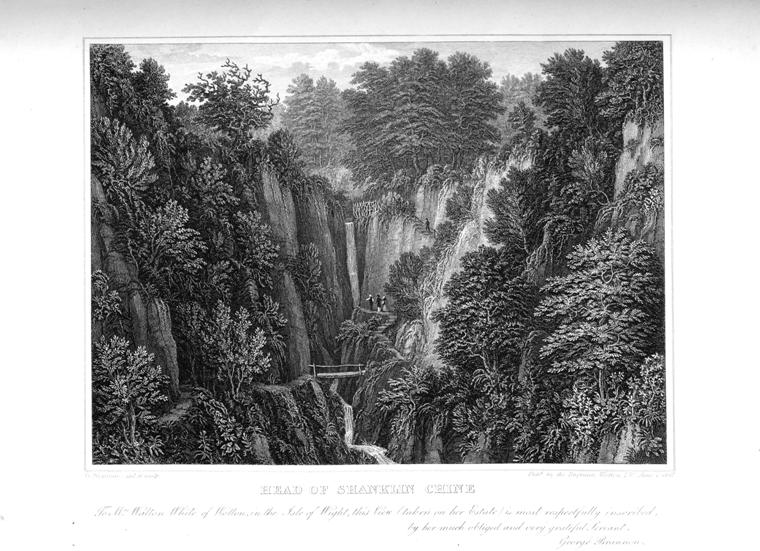
The next change of
position opens the water-fall, and the HEAD OF THE CHINE, affording generally the greatest share of
interest. The sides, still
characterized by a striking contrast, here gradually contract to a narrow, deep
fissure, shaded by the spread- ing foliage of several fine trees standing on
the verge of the precipice. The whole spot is extremely romantic and solemn.
The streamlet itself is a pleasing object; falling usually in a pretty,
sparkling cascade to the depth of nearly 30 feet; but after continued heavy
rains or sudden thaws, the effect of this increased volume is scarcely credible
by those per- sons who witness it only in a dry season : for it bounds, foams,
and thunders then in a style which few would deny to be sublime.
"E'en here, perchance, some vain, fastidious eye
Shall rove, unmindful of surrounding charms,
And ask for prospect. Stranger, 'tis not here.
————— But in this path,
How long soe'er the wanderer roves, each step,
Shall wake fresh beauties, each short point present
A different picture—new, and yet the same."
We now take our
leave, by ascending a series of rough steps cut in the side of the cliff, and pass
through a rustic wicket which opens to the village on our right. But here we
should turn to take a farewell view : and if the visitor feel any interest in
the question "How such an immense ravine was produced?" he should, in
reference to the subjoined remarks on the subject, take notice of the deep
sunken roads to the right and left; and particularly of the worn channel of THE RILL ; for insignificant as this may then
appear, there is little doubt but it is the primary agent in producing the
extraordinary scene we have just explored: the spring-head is about a mile up
the valley; and its' course may readily be traced by the luxuriance of the ash
and other trees that flourish on its banks.
o
REMARKS ON THE FORMATION OF THE CHINES.
Among the most striking
of the picturesque beauties of the
These general
remarks on the probable formation of the chines are here offered for the
consideration of the reader, because many very intelligent visitors too readily
ascribe both their origin and present condition to some violent disruption
of the land.
That the
circumstances above stated are most probably the natural cause, may be inferred
from the experience of the last 20 or 30 years, both at Shanklin and other
parts of the island.—For within this period a considerable chine, known as THE SHEPHERD'S, near, indeed branching from, another called COWLEAZE, about a mile from Brixton, originated in a
most trifling incident,—for the stream was actually diverted from its
ancient course, in consequence of a countryman having amused himself, in an
idle moment, by removing enough of the earth at the side to form a guttur,
through which the water, when swelled to the brink, found a shorter
transit to the sea. This was the incipient stage in the formation of another
chine: the old rocky winding channel was by degrees superseded; and its
rival has from that time gone on regularly increasing (evidently through the
agency of the circumstances before explained,) till it has now reached a
magnitude which renders it an object of curiosity and importance in the history
of the island. The visitor must not overlook the singular serpentine course of
the original chine, in his examination of the new one : it is in a stratum of
free-stone, very shallow, but of great length, running almost parallel with the
verge of the sea-cliffs: but its successor is in yielding strata of gravel,
sand, and clay ; which readily illustrates the theory of their respective
conditions.
[The above observations respecting Cowleaze and the
Shepherd's Chines are on the authority of several respectable persons who lived
pear for many years previous to the existence of the new chine,—and who
accompanied the writer to the spot.J
That of Shanklin
was visibly extending much too rapidly for the satisfaction of the proprietor :
who then resorted to every artificial means to counteract its progress,—such as
propping with timber and stone walls: pitching the bed of the stream and
gutturs with large stones ; planting where practicable ; and more especially, careful
draining. But had simple Nature (that fertile source of the picturesque,)
been suffered to reign uncontrolled for about another half- century or less, we
have no doubt but the head of the chine would be then removed so much higher up
as to pass considerably the present cross-road ; a result which we confess
would be most agreeable to our ideas of the sublime and beautiful, as the whole
of this charming spot would have been thereby rendered doubly interesting.
———•r^—————
FROM SHANKLIN TO LUCCOMBE AND BONCHURCH.
The road from
Shanklin to the Undercliff passes by the little parish-church (or rather
chapel,) an unpretending object in itself, but, in connection with a large old
mansion in its rear, now a farm-house, of great value in the composition of the
illimitable landscape that shortly opens to our view. After passing through a grove of extremely
picturesque ash (one of which, almost the lowest on the left, has long been
celebrated for its amplitude and beauty), the road winds more circuitously
round the steep flank of Dunnose Down (800 feet high), the scenery at every
step wonderfully increasing in extent and beauty.
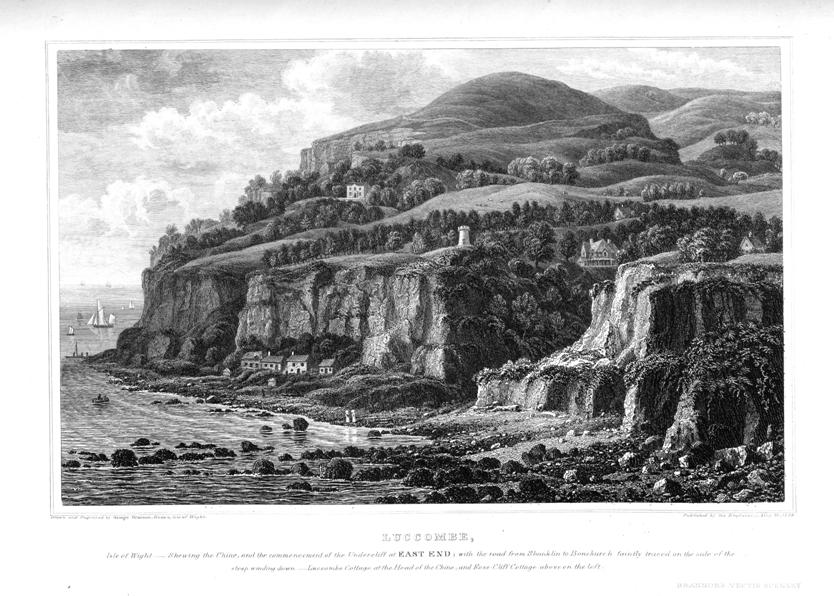
LUCCOMBE CHINE.
Between Shanklin
and Bonchurch is a deep semi-circular valley, which though far from destitute
of beauty, chiefly owes its celebrity to one of those chasms in the sea-cliffs
provincially termed Chines, such as we have already seen at Shanklin:
its features are much of the same soft character; but being very inferior in
dimensions, is not so often visited as perhaps it deserves—at least by parties
limited in time.
A gentleman's
residence occupies the head of the chine; very judiciously built in an
unobtrusive cottage style—enveloped in a profusion of the choicest creepers,
supported by a green-painted trellis-work extending over the walls of the whole
building; and is surrounded by a few fine old oaks. A mimic tower, platform,
&c., are dispersed through the grounds, and seldom fail of being noticed by
the stranger.
Another genteel
residence stands very conspicuously on a rocky slope some distance to the
south-west, built with the warm-tinted stone procured on the spot, and slated;
this should be particularly noticed by the tourist, because it is near the
public path that leads through East End, which he is by all means recommended
to pursue.
Though this
secluded spot presents nothing particular at first sight from the road
to call for admiration or a ready exercise of the pencil, still there is such a
combination of rural beauties, and such a cheerful repose pervading the whole
scene, as cannot fail to make a very favorable impression, if leisurely
examined. It is almost shut in by a fine
sweep of lofty hills : and the whole surface broken into a series of abrupt
knolls and dells like waves of the sea; attended by every animated circumstance
of pastoral life. The more precipitous
slopes are feathered by hanging copse and scattered groups of nourishing ash :
nor is there wanting the more poetic ornament of a murmuring rill. Besides the two genteel residences before
noticed, there is a large farm-house and yard snugly seated in one of the
hollows; and several laborers' cottages occupy the more sunny banks. The
ever-sublime ocean spreads its unbounded waters full in front; and the public
road takes the most tortuous course possible on the steep side of the downs, a
circumstance always considered extremely picturesque.
Such is the valley
of Luccombe, independently of its crowning beauty, THE CHINE, and a very bold piece of Shore where several
fishermen have established their rude habitations ;—altogether presenting a
picture which to us affords more pleasure than many popular scenes of much
higher pretensions,
THE UNDERCLIFF
Is the designation
of that part of the coast we are now approaching: it is distinguished for the
unique character of its rocky scenery, and extends about nine miles. But here
we must offer a caution to visitors, not to be carried on to Bonchurch without
first making inquiry respecting East End, through which the party is particularly
recommended to walk, while their carriage in the meantime proceeds on to
Bonchurch by the high-road. The
distance is rather short of a mile. But
if this plan may not prove agreeable, the coach- man should be directed to
point out the proper place where they could alight, for the purpose of looking
down on an extensive scene of desolation which lies beneath the road : for
though it is but a few yards off, there is no indication of it before we
approach close to the margin ; till then it would appear to be the edge of a
tremendous precipice over- hanging the sea.
EAST END.
This is properly
the commencement of the Undercliff,—and presents, nearly on our first entrance,
the most romantic scenery that now exists in the island ; being still left in
possession of that air of stillness and solitude, which is so enchanting to
those who admire Nature in her...
"Lovely, unfrequented
wilds."
Many centuries must
have elapsed since this spot was disturbed by some violent convulsion,—for the
precipices and detached rocks, display the most venerable aspect in their bold
projecting crags,—in their curious deep-worn fret-work,—and in the richness and
mellowness of their coloring. Single colossal rocks are scattered about in the
most picturesque confusion: while many others are combined into broken knolls,
tufted with thorn and hazel, or crowned with the greater ornament of some
wide-spreading oak or ash.
The undefined path
pursues its devious way between the rocks, trees, and thickets for a short
distance, without any circumstance to destroy the repose of the scene (save the
congenial presence of innumerable daws that nestle in the airy ledges), nor is
there any prospect to call off the calm delighted eye, till we come suddenly
upon the scene of the last great landslip, which occurred in 1818.
No part of the
island exhibits so magnificent a scene of ruins as this: though its present
appearance bears no comparison with the awful picture which it presented for
some time after the occurrence. Immense portions of the cliff were then forced
forward in a sloping direction,—still maintaining, however, a perpendicular
position, and their ancient front (which is manifest from their craggedness and
hoary tint): while other parts must have been completely overturned or shivered
to atoms in the moment of avulsion.
Some of the largest rocks were hurled to a considerable distance :
others were overwhelmed in the earth;—some stand tottering on great mounds of
the fragments^ while others again are split up in a very singular manner. Several
large elm and ash trees were destroyed—some of them presented their roots
upwards, while others preserved a footing with the moving mass, but
subsequently died. In fact no just idea
can now be formed of the terrific scene of desolation which it then presented;
for the green mantle of vegetation has been gradually shrouding its most dreary
features,—the birch, the hazel, and the thorn have long taken wide possession:
a few self-sown ashlings may be seen flourishing in the more sheltered parts;
and most probably its verdant dress will be still further improved by
plantations, wherever practicable.
o
To the inquiring
stranger this spot must afford the greatest interest; not so much on account of
its picturesque wildness perhaps, as the opportunity which it offers of
gaining, by easy examination, a solution to the problem of what were the causes
that produced the unique character of the tract of country which he has now to
pass through. As this is to every visitor more or less an interesting question,
it will not be unacceptable to subjoin the following....
REMARKS ON THE FORMATION OF THE UNDERCLIFF.
On investigating
the scenic peculiarity of this part of the island, the traveller will perceive
that the shore at
Most probably
further subsidences will yet take place at East End, until more of the oozy,
sliding foundation shall have been removed, and its place occupied by a
quantity of fallen rock sufficient to secure the stability of the ground ; as
we find to be the case for the greater part of this singular tract, which has
certainly been in a state of repose for at least seven or eight centuries.
Fragments of the cliff are indeed frequently shivered off, but rarely or never
attended with any very injurious consequences; it is those extensive landslips
which are alarming, when many acres of valuable ground are completely over-
turned and laid waste in a few hours. The huge masses of solid rock thus torn
and dashed about, produce the grandest scenes of terror, but are at the same
time the source of those singular beauties—that variety of fractured cliff and
broken ground, which are the greatest ornaments of this romantic country.
" THE
UNDERCLIFF," says the late Rev. P. WYNDHAM, "is by far the most
romantic part of the island, reaching from Bonchurch to Blackgang Chine, an
extent of about six miles: but they are such miles as are not to be paralleled
for their singularity, perhaps in the whole world. Bold cliffs, low lands, or declining shores,
are the usual boundaries of the ocean: but on this extravagant coast, a
wall-like, rectilinear precipice of lofty rock extends itself some miles in
length and at the distance of more than a mile from the sea ; in this interval
of rock and water, colossal fragments of stone, torn or sunk from the precipice
by some great convulsion of Nature, are scattered below in the most irregular
confusion. These solid masses are of
such a ponderous magnitude, that they form high eminences of the most
capricious shapes; while their intermediate spaces become deep vallies, in
which houses arc built, and even ashes and elms are seen to nourish, sheltered
from the storms and spray of the sea by the hospitable shade of the lofty
fragments. Every spot of this land, that can bear the
impression of a plough, is uncommonly fertile and well-cultivated, and enriched
by numerous rills of the sweetest water; but the fruitful patches are of all
sizes and figures, and the huge rocks, covered with briars, frequently arise
from amidst a polygon enclosure of two or three acres.
" From the above
description, some faint idea may perhaps be conceived of this wonderful
country, which from the towering hills above, appears to the eye like a level
plain : but which, when seen from the sea, rises like a series of gigantic
steps that seem to lead from the cliffs of the shore (which are even there of
great elevation,) to the summit of the grand perpendicular wall; and the reader
may probably think me justified in my general assertion of the peculiarity of
this Undercliff, as I can safely aver, that no such country ever occurred to my
observation, nor do I recollect to have seen such ever described.
"Many fresh
separations from the precipices are visible: and the spots, from whence they
descended, signally correspond to the forms of the huge stones below. These are
quite naked, and have neither mould nor verdure upon them, while the others are
concealed and covered with briars, thorns, and trees, in proportion to the
centuries that have elapsed since their original avulsion.——If the mind of any
person can remain tranquil on the first view of this wonderful country, or if
he can gaze with indifference on the sublime scene above and below him, I do
not envy the cool phlegm of his constitution, but I should advise him to
confine his future airings to the level and dusty roads that surround our
metropolis."
BONCHURCH.
A Party proceeding
from
The little
parish-church is a very pretty object, seated near the shore, "embosomed
soft in wood," and skirted by a rippling stream. To the inquisitive traveller it will be
interesting as regards the question—"how long has this part of the coast
been in a state of repose?" It was certainly built in the thirteenth
century, if not at an earlier period. But if the tourists decline going through
the landslip, and continue in their carriage, they will soon come suddenly upon
a fine burst of the Undercliff, stretching away in beautiful perspective for
about three miles. The road makes a
precipitous and giddy descent between large rocks cut down for the
purpose. When near the bottom, the
party should proceed on foot to the church,—passing through a grove of
magnificent trees; and advance for about a quarter of a mile near the margin of
the sea-cliffs ; the scenery is both soft and romantic in the highest degree,—a
close interchange of the wild and rugged with the sylvan and adorned.
A pyramidical rock
of singular picturesque beauty, called Hadfield's Look-out rises boldly
from the road, where we should stop and leave the carriage: it is generally
distinguished by a flag-staff, and used to be most frequented for the sake of
the fine prospect which it commands.—In the face of the superior main cliff on
the right as we proceed, there is also a fine prominent crag called the Pulpit
Rock, which is seldom unobserved by the passing stranger, from its bearing
a rude cross, that adds much to its beauty.
A large portion of
Bonchurch has recently been under the hand of Innovation,— or, as perhaps some
of our friends would say, of Improvement—but which of the two the reader will
probably be enabled to form some opinion for himself, if we here put upon
record what the character of the scenery was previous to the year 1837, when it
was first advertised to be divided and sold off for the purpose of erecting
a considerable number of villas, in a style suitable for the retreat of
opulence and pomp : and from that moment it was doomed to have its venerable
features defaced, and every native charm of WILDNESS and TRANQUILLITY for ever banished.
The whole of the scene
was distinguished by the boldest variety of surface, and a range of cliffs, the
most interesting for their craggedness and tone of coloring that could possibly
be imagined. No part of the Undercliff
was so much admired by all tastes,—it was considered Fairy-land
itself. Many were the huge rocks seen
rearing themselves in lofty pyramids of the most picturesque forms and
grotesque appearance: or spread into grassy terraces of considerable extent,
enriched by the ivy's vivid green, and the light waving foliage of self-sown
ash, firm-rooted in the deeper clefts ; groves of magnificent elms intermingled
with knots of the choicest exotic shrubs, alike nourishing in the open air :
here a genteel cottage-residence ; there the lowly habitation of a fisherman or
peasant, almost concealed in luxuriant flowers and ivy mantling to their
chimney-tops. Every dwelling was
thatched with, straw (so conducive to harmony of effect), and seated among the
towering rocks and ridges in a way to be shut out from each others view. There
was nothing in the whole scene obtrusive or alien in appearance:
—for even the abodes of the rich were quite in character—homely and
unpretending, comfortable rather than elegant in their construction. In short,
every feature, however minute, was of a harmonising complexion,—each
contributed its share to the production of a SPLENDID WHOLE,—a Picture of the most delightful keeping in
light and shade, in coloring and composition, that the island could produce.
As, however, the
opinion of artists on the question of rural beauty, are often at
variance with the public taste, it is but fair to present another view of the
subject, such as a professional builder might be expected to draw.
It must be admitted
then, that under all circumstances, the place cannot but be EXTREMELY
PRETTY,—though certainly much less
so to those who prefer Nature in her rudest attire to all the
embellishments which Art can pos- sibly bestow. But to those, on the other hand, who can
trace no beauty in an old ivied rock or grey craggy cliff, nor feel any charm
in threading the rough ups and downs of a wild piece of ground ;—where nothing
salutes the eye that is gay and animated, and the only relief to the dull
solitude of the waste, is a few straggling sheep or shaggy goats browsing on tufts
of thorn or gorse,—undoubtedly to persons of this taste, the scenery will be
infinitely improved : for it will be studded with gems of the most polished
aspect,—and if not romantic, will be decidedly elegant and imposing.
Indeed, when the
undertaking shall have been completed according to the plan which has been
published, and after the lapse of a time sufficient for vegetation to lend a
softening grace ; the whole will, we think, present as great a diversity of
prettily designed houses as were ever brought together in so small a compass :
and must afford many points of highly picturesque effect. In. short, it. will be popularly deemed a
most beautiful place: and deservedly ought to enjoy a high reputation as a retreat
for invalids during the winter season.
The road which we
take through Bonchurch is in a narrow valley or glen, formed by steep broken
slopes and lofty cliffs on the one side : and on the other by a long ridge of
colossal rocks, united with heaps of fragments, that were dissevered from the
parent cliff, in all probability, above a thousand years ago : this ridge shuts
out our view of the sea, and several of the new villas, which are close
by. Altogether the scene is enchanting
: the road winds beautifully under an avenue of venerable elms ; and a
sparkling rill plays at its side, in one part spreading into a small
translucent lake, ruffled only by the sportive fish and fowl. The eye is
carried over this pleasing feature, and the checquered plantations that
luxuriantly robe the opposite bank, to the mountain brow of St. Boniface Down,
which closely overlooks the scene, and forms a most picturesque boundary to our
view.
ST. BONIFACE COTTAGE presents itself on our emerging from the
shades of Bon- church, most agreeably seated at the foot of a steep down, which
gives the name : it is in a very pleasing style—built with free-stone, and
thatched; the situation possesses every beautiful feature of this romantic
country, and unites in an uncommon degree the comfort of sheltered retirement
with the advantage of a fine sea-prospect.
St. Boniface Down,
the side of which is so exceedingly steep that but few persons can easily climb
to the top, forms an interruption in the grand line of land-cliff for about
half a mile: consists principally of chalk, covered by a scanty broken, verdure
: and on its summit is a never-failing spring of the purest water. We come now in sight of...-
VENTNOR.
This
fast-increasing town dates its creation so late as the year 1829: for
previously to that time it could boast of not more than three or four laborers'
cottages, a small farm house, a humble grist-mill standing on the edge of the
sea-cliffs, one hotel, and a snug little inn; altogether but a very small
population. As the reader would most
probably like to know the circumstances which led to its sudden and rapid
growth, we will here introduce its brief history :
Dr. James Clarke,
who has distinguished himself by an able "Treatise on the Influence of
Climate in the Cure of Chronic Disorders," had been over the Continent of
Europe, and through the
About the time of
the first appearance of Dr. Clarke's work (or at least soon after), the
proprietor of the whole of the land at Ventnor, determined to sell off a large
portion of his estate for the purposes of building: it was well-timed-for land
offering eligible sites for building on could then scarcely be had for any
money. The speculation took
astonishingly: land soon advanced at the rate of from 100 to £.400 per acre,
and even much higher in very choice spots.
To forward still more the rapid advancement of the place a private
gentleman in the neighbourhood (JOHN HAMBROUGH, esq, of Steephill Castle ) munificently built
at his own expense the most beautiful church we have m the island,—a
respectable parsonage-house,—and a very commodious parish-school.
Nothing accurate
can be expected by the reader, in the way of minute description respecting a
place still in progressive improvement.
In a picturesque light, it has but little to boast of at present in
itself, beyond the church: for although there is a profusion of trees and
ornamental shrubs planted about, none have yet reached any considerable size,
so as to afford a relief to the confused appearance in the disposition of the
buildings ; an unavoidable evil for some time to come, arising partly from the
openings left for future houses, and still more perhaps from the want of a
judicious ground-plan which ought to have been originally settled upon. This would most likely have been done, had
the proprietor anticipated the demand which was so soon to have been made for
his land : for the streets which have been latterly laid out are less
objectionable.
The scenery by
which Ventnor is closely environed is as beautiful as any part of the Hand;
stretching from East End and Bonchurch on the one side, to Steephill and St.
Lawrence on the other: a mile or two northward extends the fine park and estate
of Appuldurcombe; and spread before it in unlimited prospect appears the mighty
ocean- affording a perpetual source of delightful speculation.
The coast about
Ventnor is of a bold character; and the Cove, particularly at certain times, is
very gay and pleasant; busy fishermen pursuing some part or other of their
avocation.-and numbers of genteel parties sauntering or reclining on the sunny
beach, listening to….
"The hollow murmurs of the ocean tide."
The material of the
shore is principally very small pebbles, averaging about the size of a pea .
and it deserves to be mentioned, that particles are frequently picked up
possessing a brilliancy which has gained for them the name of "Isle of
Wight diamonds :" they are eagerly sought after by the inhabitants and
parties lodging m the place : and although they may be intrinsically but of
very inferior value-still, the interest taken in searching for them is a
source of the most agreeable employment, especially to those visitors whose
health precludes any exercise of a more active nature.
We shall now close
our account of Ventnor with stating (what is not a little interesting to most
tourists, as well as those intending to sojourn for a time,) that the place is
well supplied with Hotels and Inns, vying both in dimensions and accommodations
with the best in the island-, lodging-houses of every grade and position, some
on the margin of the sea-cliffs, others on the airy heights overlooking the
lower and crowded part of the town:—shops in almost every line of business
required in the country ; post- office, branch-bank, reading-rooms,
bathing-house and machines; architects and solicitors; and, of still more
importance in a place to which invalids and valetudinarians especially resort,
several stationary physicians, surgeons, and apothecaries.
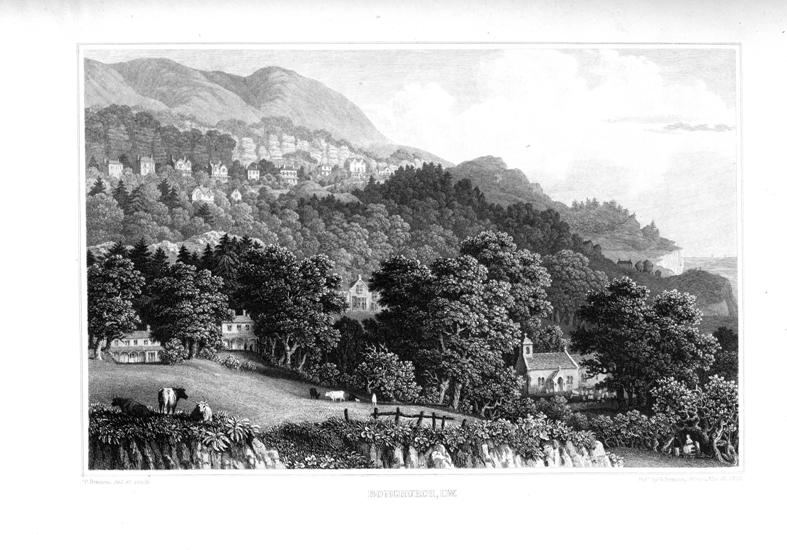
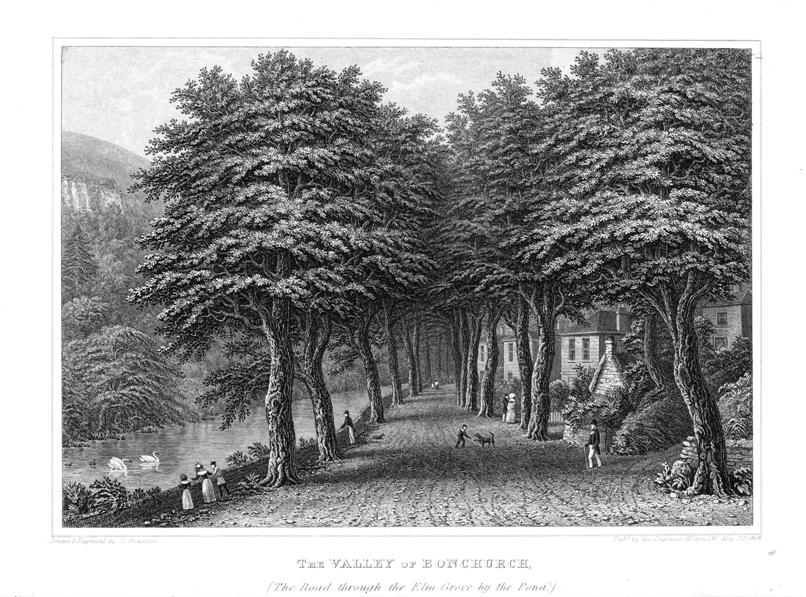
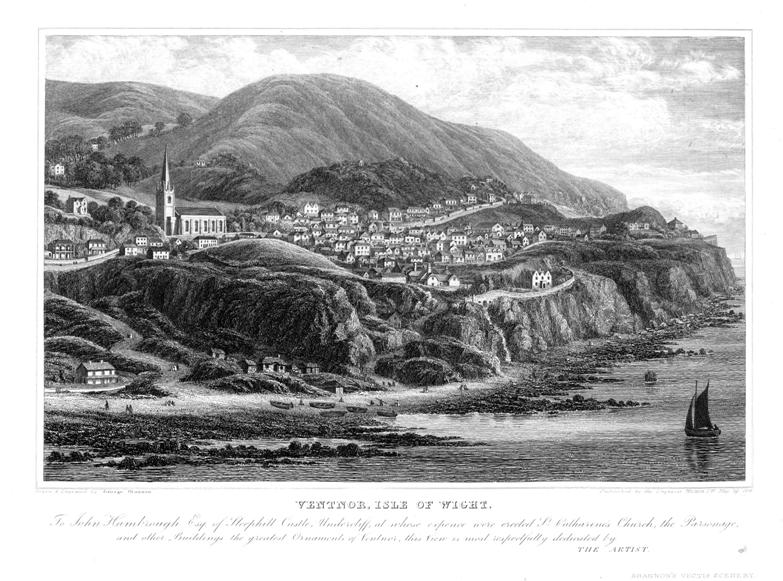
A short mile brings
the tourist to some farm-buildings marked by an antique air, which belong
to....
But the road here
makes so sudden and steep a descent as to preclude a view of this noble
edifice, which occupies a rocky terrace on our right. A path however leads through a plantation on
the left, where...
"From craggy cliffs between the verdant shades,
The crystal streams rush down in bright cascades,"
and gradually
ascends to the brow of a bold promontory overlooking the shore, which opens the
principal part of the building, and a charming prospect. A flag-staff a little below marks a small
romantic CAVERN in the face of the precipice.
The Castle was
completed in the year 1835 : is in a style of chaste elegance; combining all
the advantages of a regular-built mansion with the picturesque exterior of this
more commanding style. Several of the rooms are of the most handsome
dimensions, and the whole interior arrangements are considered extremely
judicious and convenient. The body is of an oblong figure, and the chief
ornament a fine square tower which springs from the middle on the northern
side. The stone of which it is built was procured on the spot; and being of a
dark grey and a warm yellowish tint, affords a beautiful contrast; yet produces
a sober tone, harmonizing well with the surrounding scene. The site is that of
a thatched cottage which was for many years the favorite residence of the late
Earl Dysart.
Several rustic
cottages that stood at Steephill, and gave it the character of a hamlet or
village, were removed (much to the advantage of the occupants), in order to
afford more scope to the grounds, corresponding with the magnificence of the
house.
The general
features of the landscape may be described in the words of Cowper:
"Banks cloth'd with flowers, groves fill'd with sprightly sounds;
The yellow tilth; green meads, rocks, rising grounds:
Streams edg'd with osiers, fatt'ning every field,
Where'er they flow, now seen, and now conceal'd."
It is to be
regretted, that the public are not admitted within the near grounds of
Steephill: for neither the ornamental detail nor the complete design of the
castle can be seen to any advantage at a distance. But the exclusion from the gardens is still
more to be lamented, for they are enriched by the most valuable specimens of
exotic flowers and shrubs, which the genial situation renders as luxuriant
almost as if indigenous to the soil.
FTHE EXCLUSION OF STRANGERS FROM MOST OF THE
COUNTRY SEATS—having been often inveighed against rather inconsiderately, we
feel it our duty here candidly to state in extenuation, that we know several
gentlemen who would freely open their gates to respectable visitors, provided
they could be assured of every party being contented with a general view of the
local beauties, without indulging a too prying curiosity: and at the same time
would refrain from picking choice flowers, fruits, or shrubs, many of which may
perhaps have been cultivated by the hands of the owner with an affection of no
little solicitude and pride; and of course it is not always convenient to keep
a person merely to act as an attendant. But a more decisive reason with many gentlemen
who love retirement is, that from the island becoming every year more and more
attractive to pleasure-parties, and unlimited admission of strangers would at
once annihilate all the charms of rural seclusion; it would, in fact, be
converting the flowery walks of a quiet country villa into as giddy a promenade
as any popular tea-garden in the suburbs of our metropolis. Still, however,
speaking generally, it only requires some slight grounds of introduction: and
in the absence of the family there is of course less difficulty,—it being then
a privilege often given to the servants.
About half a mile or
less from Steephill, we get an interesting catch of its splendid castle, just
as the road takes a rise. We next
arrive at the romantic and celebrated village of....
ST. LAWRENCE,
"With woods o'erhung, and shagg'd with mossy rocks.'*
The first object
that will arrest attention is a small piece of architecture at the road- side,
called THE WELL, inclosing a fountain of ever-running crystal water. It is ex- tremely tasty,—peeping from
beneath a richly checquered grove of trees, which dress the steep slopes at its
back ; the light foliage of willows wave gracefully over it, and the cobea and
other flowering plants often deck it with their gay festoons.
Opposite is a
charming villa erected many years since by Sir Richard Worsley, the well-known
historian of the Isle of Wight; and another, recently built by Capt. Pelham,
R.N.; both quite secluded from the public view, unless by taking a foot-path
that leads to the preventive-station—we are then in a fine open lawn that
spreads from the garden-fence to the sea-cliffs, and have a good view of the
grounds, the cottages, and several minor architectural embellishments.
On the sea-cliffs
are two small forts mounting several guns and carronades : and at a short
distance is a long, slated building, occupied by the men (arid their families)
be- longing to the preventive service.
Though St. Lawrence
can boast of no individual feature throughout that is particularly attractive,
yet as a whole it is both beautiful and romantic in the highest degree.— There
is one circumstance attending it which well deserves to be noticed, and which
in- deed may be said to be almost peculiar to it; we mean the absence of all
that glittering decoration and repulsive parade which characterise most
gentlemen's seats,—for a seat in fact is the whole of St. Lawrence. And it is also very gratifying to behold the
humble dwellings of the poor in such close neighbourhood to the residence of
nobility, exhibiting as these do, a degree of neatness and domestic comfort
which imply a much happier condition than is generally the peasant's fate. Many a time have we lingered with pleasurable
interest too in viewing their picturesque character: for most of them are so
very romantically seated among the rocks and groves, as to resemble more the
warm nestlings of birds; and require almost as much looking-for to be
discovered : each is surrounded by its well-stocked fruit and vegetable
garden,—roses, myrtles, and other fragrant plants thickly weave around their
doors and windows,—and ivy or Viginian creepers mantle the thatched roofs.
"The grassy lane, the wood-surrounded fields,
The rude stone-fence, with fragrant wall-flowers gay ;
The clay-bulk cot, to me more pleasure yields,
Than all the pomp imperial domes display."—SCOTT.
Kit" It is much to be regretted, that the public are (or were,) wholly excluded from the open field in front of the villa ; and what is more remarkable, even from the path on the edge of the sea-cliffs !
The PARISH-CHURCH
OF ST. LAWRENCE is allowed to be among the smallest in
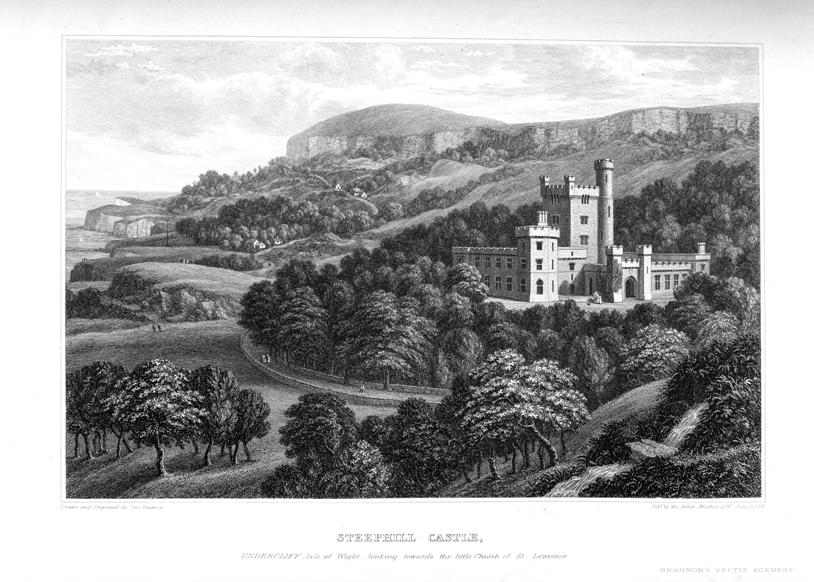
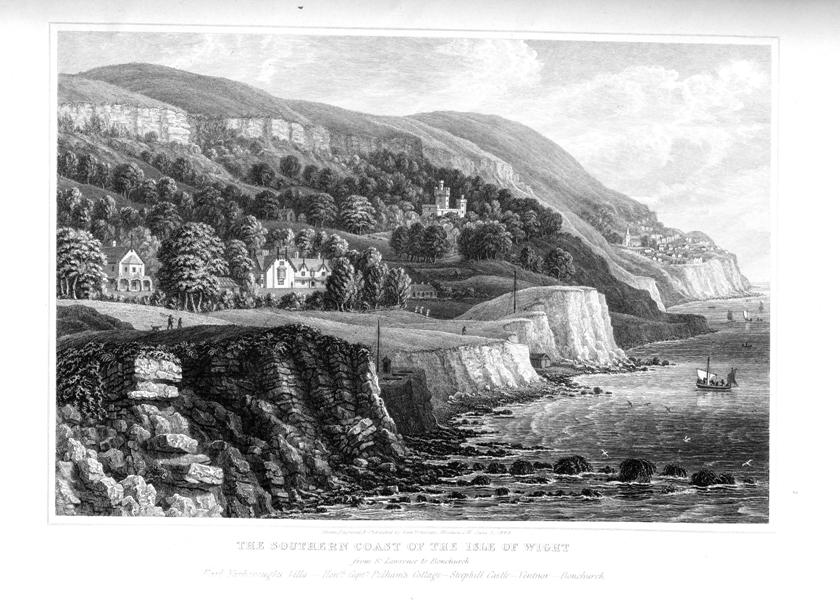
THE ROAD FROM ST. LAWRENCE TO NITON.
For about the next
mile and a half, the country is comparatively uninteresting in point of
artificial objects of attraction: but probably the traveller will be quite as
well pleased, and agree with the painter and the poet, that...
"There is a grace in wild variety,
Surpassing rule and order."
For here we have
frequently that delightful union of romantic and rural beauty so characteristic
of this picturesque country;—a bold variety of broken ground and fractured
cliff, harmonised by congenial brushwood or mantling ivy: intervening marks of
cheerful cultivation, and the quiet presence of some humble cottage almost hid
among rocks and trees;—the public road too, not yet confined between high parallel
stone walls to the narrow breadth of a town-lane; nor densely planted on either
hand to the provoking exclusion of all prospect. In fact we have, in this
highly favored spot, many of the genuine features of the Undercliff in all the
lovely simplicity of Nature.
We call this
"a highly-favored spot," not that it is so eminently distinguished
for scenic beauty: no; but because it is, as yet, spared the wide-spreading
infliction of London-like improvements. But we fear, from the increasing
celebrity of the Undercliff as the most desirable retreat in
o
OBSERVATIONS ON THE CHANGE IN THE SCENIC CHARACTER OF THE UNDERCLIFF,
And on the Objectionable Styles of Building,
The tourist witnessed
at Bonchurch and Ventnor the change which the aspect of the scenery is
undergoing, thro' the rage for building; and it is not a little remarkable,
that the same metamorphosing spirit has reached even the neighbourhood of
Blackgang Chine, which is the termination of this interesting portion of the
coast. That such would be the fate of
the first, being the most lovely part of the island, we had every reason to
apprehend ; but we never anticipated that the inhospitable region of the latter
was so soon to be likewise disturbed by builders' operations.
We have before said,
that in the case of Bonchurch, it could not be improved, because formality and
capricious taste would no doubt have a large share in the undertaking; but the
neighbourhood of Blackgang may really be greatly improved ; and from being a
dreary waste of sliding mud and falling rocks, will be gradually cultivated,
and its most savage and repulsive features softened down to a more agreeable
state. Indeed it could, we believe, be made even an interesting landscape,
though of a stern aspect, were the buildings and the management of the grounds
to be IN A STYLE TO CORRESPOND WITH THEIR PECULIAR LOCALITIES,—that is, whether
the site be sheltered or exposed ; ample or confined ; soft, rugged, or
romantic.
That such a principle
ought to be attended to by architects and builders, few of our readers will
dispute ; and as the departures from it are so numerous in the island, we feel
it our duty to expose and reprobate the neglect.
The most common error
in building, as regards the harmony of the scene, originates in the vanity of
glare—of preserving "respectability "by an ostentatious exhibition of
property and station. Hence arises the
incongruity of erecting a splendid town-looking house, with a stately gateway,
and other imposing appendages—in the midst of a romantic theatre of rocks,
precipices, and broken ground. Here, surely, sound taste would dictate the
choice of the most unpretending rusticity of style in every line of the place.
Another example of
injudicious building, is posting a light and fancifully decorated house on an
exposed eminence} where the surrounding country betrays the poverty of Nature
in all her vegetable productions; and where the fanning breezes are ever tuned
to a shrill whistle or a mournful howl, as they play in eddies around the
multitudinous breaks, angles, and prominent ornaments. But place one of those
elegant and airy structures in some congenial spot —sunny, sheltered, and
luxuriant, and then the eye and the reason will be equally satisfied.
The opposite to the
above inconsistency is that of thrusting a stately mansion in the narrow recess
of a barren hill or elsewhere, of scope sufficient only for a peasant's cabin and
patch of garden. In .this case we are
presented with the anomaly of Opulence preferring a seat in the lap of Penury :
for such we deem a large showy residence erected in a spot so contracted as to
preclude all those accompaniments which give the finishing grace to
architectural magnificence,—such as a modest lodge-entrance at a proper
distance from the house, a shrubbery, a few scattered groups of trees; and if
not a park-like display of grounds, at least an extent sufficient to obviate
the annoyance of public curiosity,
The last impropriety
to which we have room at present to advert, is that of placing a residence of
the castellated form in any situation to be overlooked and commanded: and
certainly is contrary to the idea we associate with the presumed purposes of
such an object.
Now in those
situations which ought to preclude ostentation and elegant decoration, and yet
the house must be roomy, no style perhaps is more generally applicable than
that of the Swiss Cottage; because it admits, under one roof, a considerable
number of apartments, as well as offices ; is extremely picturesque and
comfortable in its appearance, and may be placed almost in any position—on the
mountain's brow, or at the foot of a precipice. Next to the Swiss, the plain thatched
Cottage of our own country; such a one for example as was at Steephill, for
many years occupied by the late Earl Dysart.
The castellated order
also admits of very general application,—is extremely picturesque and
varied—and accommodates itself to all dimensions. It may be little more than a
simple tower crowning a bleak promontory or craggy cliff, or it may be ample as
a citadel itself: may have a solitary existence in a wide tract of sterility or
on the sea- shore (provided it be not overlooked) : it may proudly rear its
lofty turrets in the very heart of a city; or be sequestered in the trackless
solitudes of a forest. In fact it is a species of architecture which absolutely
requires neither groves nor streams, nor any other local ornament, to render its
appearance complete.
But not so of other
descriptions of building—each has its peculiar character to support, according
to the circum- stances of its PARTICULAR LOCALITY. And from a neglect or ignorance of this
principle, arises that incongruity which destroys the agreeable effect of a
landscape: for although the house and grounds, separately taken, may be
beautiful and interesting, but not harmonising—not reflecting any reciprocal
aid to each other,—the eye of taste cannot view such a discordant scene with
any degree of satisfaction.
Now it would be well
if gentlemen who take up their residence at this part of the island, would
determine that their habitations should be of a design to harmonise with the
demands of local propriety : and particularly, not to pro- ceed with a rash
hand in exchanging any one genuine line of the place for "pretty
effects!" or any of those trifling elegancies that are more proper to
grace a Chinese pleasure-house or a metropolitan garden.
" Great Nature scorns control; she will not bear
One beauty foreign to the spot or soil
She gives thee to adorn; 'tis thine alone
To mend, ml change her features."
The reader, if he be
at all an amateur of the picturesque, will, we are sure, pardon this
digression, and equally deprecate that false taste which too often prefers
splendid littleness to noble simplicity.
He will have occasion more than once to remark before he leaves the
island, how much primitive beauty is injured by fanciful embellishments and
injudicious alterations; it would be a solecism to call such refinements by the
designation of improvements; where in fact it might seem to have been the aim
of wealth,
————"And all that toil,
Misled by tasteless fashion, could achieve,
To mar fair Nature's lineaments divine,"
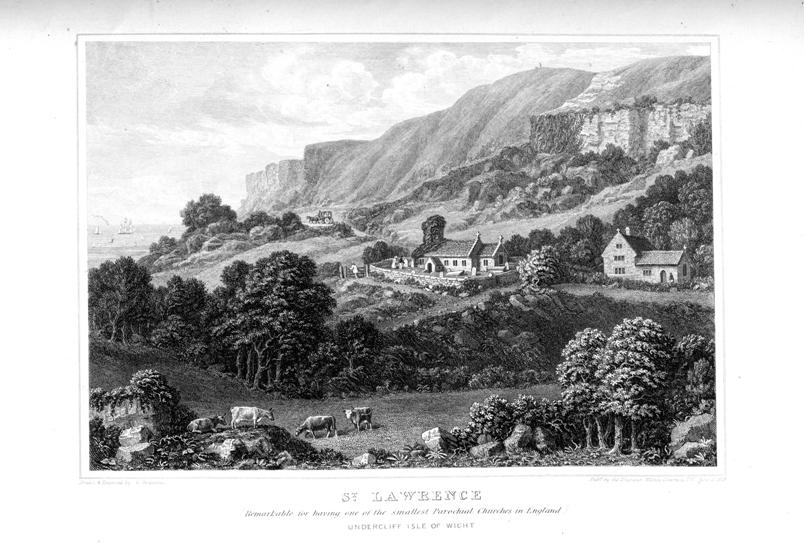
THE UNDERCLIFFE, NEAR NITON.
We soon pass thro'
the umbrageous plantations of another villa, called MIRABLES, from its amenity
of situation, and romantic accompaniments of scattered rocks and purling
streams. The dwelling is of a plain,
rural construction, seated on a broad green terrace, from which the ornamented
grounds fall with so rapid an undulation to the beach, that from the rooms it
would seem to be the margin of some bold promontory overhanging the sea.
Near Mirables is CRIPPLE-PATH, a very romantic ascent to the top of the
upper cliff, curiously formed in the ledges by the gradual mouldering-away of
the softer sand-rock strata. The party may here quit their carriage, as they
can safely walk on the edge of the precipice as far as Niton : at all events,
it is worth going to the top of the cliff, for the sake of gaining an extensive
prospect of this charming line of coast.
THE ORCHARD is a
lovely retreat, adjoining Mirables, built in the embellished villa style. The
grounds close in front consist of narrow, deep-walled terraces, clothed with a
profusion of the choicest fruit-trees, which nourish here with extraordinary
luxuriance; and the coping is adorned with a number of handsome flower-vases
and other similar decorations, which contribute much to the pleasing effect:
the house is slated, irregularly built (being the growth of many successive
additions); and stands off at a very small distance from the public road;
enjoying, in common with all the seats on this coast, a magnificent prospect of
the sea.
BEAUCHAMP is a genteel, pretty cottage on the opposite
side of the way, nearly excluded from public view by a thick plantation of various
trees.
PUCKASTER COTTAGE :
this is a beautiful subject, everyway answering to the requirements of this
chaste but most picturesque style of building, except perhaps in its roomy
dimensions. It is seated close under a rocky ledge and two very large fragments
of the fallen cliff, on the lower side of the road ; and derives its name from
the little cove below : the situation participates in general of the same
romantic features as the neighbouring villas.
The sea-front is a bold semicircle, with a broad overhanging thatched roof that is supported by the
trunks of trees, round which are trained a variety of flowering plants,
climbing about the walls sufficiently to add a sweetness of effect, without
concealing too much of the ornamental minutiae, which are particularly neat.
At a short distance
from Puckaster Cottage, the road makes a sudden turn to the right, discovering
a very social and picturesque scene, being enlivened by the presence of several
genteel, pretty houses, with their luxuriant shrubberies and gardens, and
interspersed with grey rocks and beautiful old craggy cliffs :—for this part of
the Undercliff also shows evident proofs of its having been convulsed at some
remote period. We are soon stopped by the high stone wall of a gentleman's
villa: on our left the road pursues the westward route; and on our right leads
to the
In the immediate
vicinity of Niton are several very delightful residences, extending principally
along the Undercliff, some of which have been already passed : Puckaster was
the last one noticed: but as we proceed on the westward route, we pass a
gentleman's seat called WESTCL1FF, between the road and the grand boundary-line
of cliff: this is scarcely inferior to any of the others in point of amenity of
situation, and neat style of building : it enjoys a rather open aspect; and
having a central bow and slated roof, may be readily distinguished, especially
as it is shaded by a handsome clump of trees.
THE ROYAL SANDROCK HOTEL will
next present its interesting front,—equally so from the comfortable
country-seat appearance which it possesses, as from its ample means of
furnishing travellers with the best accommodations.
A little beyond the
hotel is a respectable private residence called
ST. CATHARINE's LIGHT - HOUSE,
Which was commenced
in the year 1838, two years after the wreck of the Clarendon, off Blackgang
Chine ; and it is to be sincerely hoped, that it may happily prove useful to
seamen by warning them not to approach if possible near this fatal shore in
stormy weather. The uncommon altitude
of the tower, rising to the noble height of one hundred feet from the surface
of the ground, and capped by a splendid lantern of about twenty feet more,
renders it a most conspicuous, indeed we may say elegant, object: and nothing
of an architectural character could be imagined so well calculated to call off
the eye from the dull monotony of this cheerless part of the coast. As the
necessary apartments for the light-keepers range round the foot of the tower,
and are only one story high, it presents at a considerable distance more the
appearance of a magnificent column, especially as it stands near the edge of
the sea cliffs, which are about 50 feet high. It is the only one besides that
on the Needles Point which is in an efficient state now in the island : for the
one built between forty and fifty years ago on St. Catharine's Hill was never
appointed ; having been abandoned when nearly completed, from an opinion, it is
said, that its position was too high ever to be useful, as the crown of the
hill was generally enveloped in dense mists during stormy or foggy weather. It
may be interesting to some of our readers to be informed, that although the soil
is composed principally of rock, it was found necessary to sink no less than
thirty feet to find a secure foundation—which is constructed of solid masonry.
47
The Country between Niton and Black-gang-
Chine.
We are now entering
on a description of scenery which though still the Undercliff, possesses none
of those tranquil, sylvan features which so delightfully characterised the
previous part of our tour. Every line
betrays a bleak exposure and the instability of the ground : and of its having
been (comparatively speaking,) but recently
disturbed by some convulsion of Nature, such as we have already seen the
effects of at
THE SANDROCK SPRING
Is situated about a
mile to the southward of Niton ; and was discovered some years ago by Mr. WATERWORTH, a surgeon of
On a green ledge
directly above the spring, stands the DISPENSARY
COTTAGE, built in an appropriate style for its bleak
situation : here parties often stop, and invalids drink the water drawn fresh
from its source.
From the Sandrock
Spring to BIackgang Chine, and indeed the whole of this neighbourhood, the
landscape was as dreary as could be found perhaps in any part of the kingdom
previous to the year 1837 : at that time a gentleman of property commenced the
bold experiment of reclaiming it—of subduing and changing its repulsive
character of one wide waste of shifting mud and tumbling rocks,—to be a safe
foundation for respectable habitations, adorned by gardens and
plantations. Here the reader may
probably ask, by what means was so unexpected a change effected ? In answer, simply by the place being thoroughly drained, at a very
considerable expense,—common agricultural tiles having been principally used
for the purpose.
There are already
seven or eight new houses erected, and others are in contemplation, which will
certainly give the scene a more cheerful aspect; and besides, the face of the
country will now be covered with a healthy and perennial herbage, and the
frightful gaps and fissures which deformed the surface, gradually disappear.
Little can be said
in further in the way of description, for the place must necessarily x exhibit
for many years a rather singular character : possessing neither the interest of
its original savage wildness, nor in any considerable degree the genial charms
of sheltered retirement or polished amenity.
There is one
advantage, however, that the whole of this neighbourhood possesses over almost
every other part of the coast,—we mean the enjoyment of the refreshing breezes
that are constantly drawn up from the sea. In the sultry summer days, when in
some parts the heat equals the temperature of the East Indies, this spot is
comparatively cool and pleasant; if therefore it is anything but desirable to
invalids during the winter months, it makes ample amends in that season of the
year when the relaxed system stands most in need of renovation.
BLACKGANG CHINE.
*
The reader will
remember, that at Shanklin a rather copious description was given of the general character of the Chines, which
was to serve as a sort of introduction to all the others. It was then observed,
that Blackgang, though altogether of a different complexion, shared equally in
the public estimation with that more lovely spot: for here all is savage and
impressive grandeur ; not a spray of waving foliage-no moss and ivy-mantled
rocks—nor any other soft or cheering object is found to shed a grace upon its
frowning aspect.
Being composed
chiefly of a dun-colored clayey kind of earth, mixed with veins of sand and
gravel, the general hue deepens tea murky black when the ground is saturated
with wet; and in this condition much of the surface becomes the consistence of
yielding mud, and therefore is in a state of constant decay. The only relief to the predominant sable tint
is, two or three horizontal strata of yellowish free stone : “which appear,” as
it has been justly remarked, "like vast courses of masonry built at
different heights to sustain the mouldering hill.
The sides of the
chasm are nearly 500 feet high, measuring from the beach ; while a steep hill
rises immediately above for about 400 feet more, crowned by two old towers,
that are preserved for the purpose only of a landmark to ships approaching this
dangerous coast The scanty rill, to
which we ascribe the origin of this tremendous ravine, falls perpendicularly
over a stubborn ledge of sand-rock seventy
feet high, which is so worn in at the base as to admit, when there is no
current of wind, of parties going between the fall of water and the cliff,
without being wetted more than would arise from the misty vapors. During a long continuance of dry weather in
the summer, it is of course little more than a noiseless dribble ; but when
swelled to a formidable bulk by the winter torrents from the hills above—it has
then indeed a splendid effect, especially when viewed from within the large
basin-like cavity that receives it on the beach.
The descent to the
shore (which affords altogether the best view of the scene,) is attended with
some difficulty and fatigue to those who are weak and infirm, if the ground be
wet at the time. Under such
circumstances, however, we would recommend the visitor to try, at all events,
to descend to the new bridge, which
is generally practicable
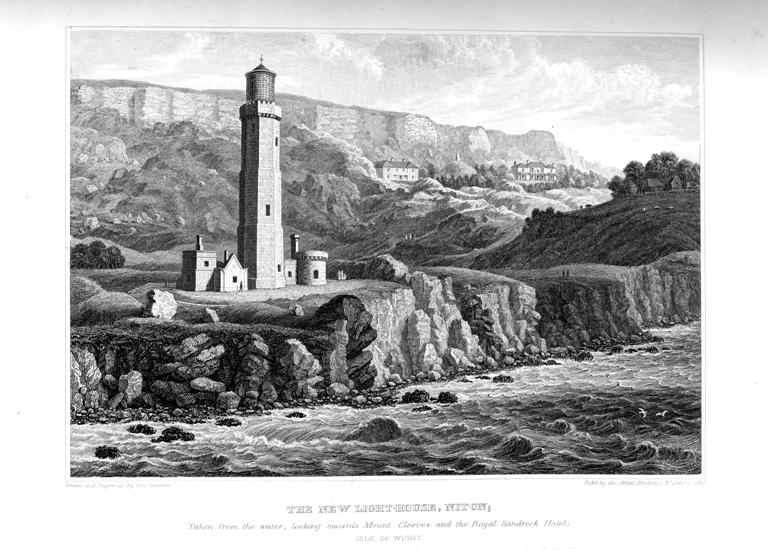
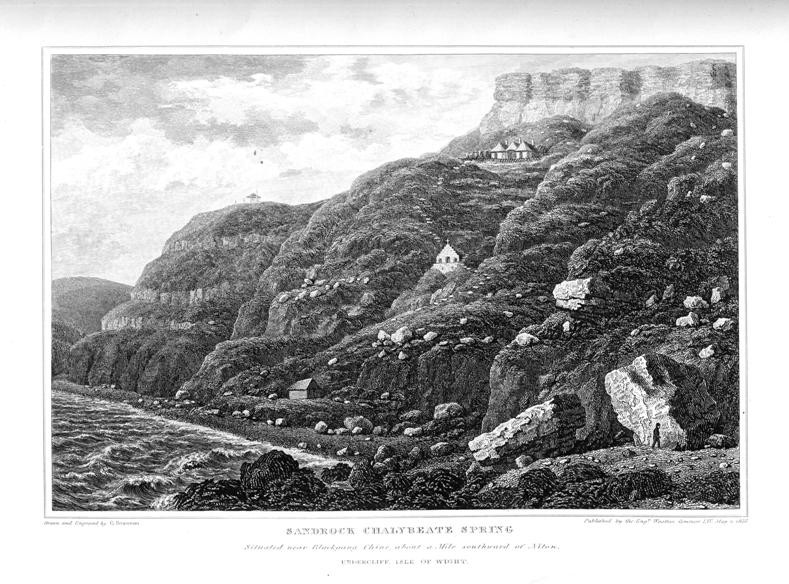
without much inconvenience ; and here he may form a tolerably good idea of the character and dimensions of the place. The bridge to which we allude was thrown across the streamlet for a private road round to a gentleman's mansion, that stands back in a recess on the other side of the promontory ; which we deem a most fortunate circumstance: for certainly the presence of any such manifestation of artificial splendor would instantly destroy that UNITY OF CHARACTER—that threatening aspect of savage magnificence— which constitute the peculiar interest of the scene. Indeed, we have often heard travellers affirm that Blacking possessed an awfulness of features which rendered it “truly sublime.” But no such objection would lie against some rude cabin of a poor fisherman or smuggler—seen screening itself from the sea-blast in one of the folds of the chasm ; on the contrary, it would prove rather an appropriate ornament.
Those strangers who feel an interest in viewing Nature under her most solemn aspect's should visit Blackgang during a tempestuous and gloomy state of the weather: all then is congenial horror; especially if some unfortunate ship should be at the moment in sight driving before the gale and in danger of being stranded on this fatal coast. But as it would he almost impracticable for ladies and invalids to visit it during a violent storm they should avail themselves of a dry day when there is a strong breeze. The appearance of the sea is then exceedingly grand : the surges mount the cliffs in dazzling sheets of foam : and the deep thunder of the waves as they break in lofty curls upon the beach, may be heard for miles. The streamlet too, if supported by recent rains, forms a fine cascade as it tumbles from ledge to ledge of its steep descent: and its murmurs mingling with the whistling sound of the wind rushing through the hollows of the cavern, and the loud roar of the breakers on the beach, all aid in producing a sublime effect.
There has long been a tradition that Blackgang Chine was formerly the favorite retreat of a gang of pirates, and from that circumstance its name was derived.——Without disputing the fact of its having offered occasionally concealment and a safe depository to smugglers or even pirates for a time,—it is equally if not more probable, that it is indebted for its very expressive appellation to its sombre coloring, and the step-like appearance of the strata. if the word gang be admitted to have the same signification as it has in a ship.
Immediately at the head of the chasm is a large hotel taking the name of the place.
In the cliffs between this and
Freshwater are several other Chines on an inferior scale, partaking more or
less of the same sterile aspect: such are Walpan, Whale,
The shore contiguous to Blackgang on the east is called ROCKEN-END, being- composed, as the name imports, of vast confused heaps of rocky fragments that have been in the course of ages precipitated from the cliffs above, and which serve to mark the gradual depredation of the waves upon the coast. To the westward lie other formidable reefs named from the nearest villages, Atherfield, Chilton, and Brooke: they are extremely dangerous to vessels drivin before a tempestuous S. or S.W. gale, or approaching too near in foggy weather, and occasion frequent shipwrecks—though of course not so many as before the erection of the new Light-house, when scarcely a winter passed over without one or more of these dreadful catastrophes.
50
LOSS OF THE SHIP “CLARENDON”
But the most disastrous wreck that has occurred
on our shores for the last twenty years, was that of the above ship, on the
11th of October, 1836, exactly opposite Blackgang Chine. She was of 350 tons
burthen, laden with sugar and rum, from the
In this horrible situation the vessel remained for about five minutes, during which the convulsive screams of the unhappy sufferers might be heard, and many of them distinctly seen in all the agonies of despair, clinging to whatever could afford them a hold. But short, alas ! was their distracting suspense : for ere any measure could be taken for their escape, the ship was stove in by one tremendous surge, bursting over her with such inconceivable force as to wrench the hull into a thousand pieces.————We shudder at the recollection of the scene that followed ; the shattered hull, the broken masts, yards, sails, and rigging,—the ponderous goods which composed the cargo,—and (most appalling to behold,) the naked and lacerated bodies of the lifeless crew and passengers, tossed about and intermingled in the whirling breakers, or hurled in dire confusion on the stony beach.
Only three escaped, the mate and two seamen
;—two who hazarded swimming through the surf, and one who was washed overboard
; and it was with the greatest difficulty that these were rescued from the
retiring wave, after being flung ashore:—all the others, it is supposed, must
have perished at the awful moment when the vessel was stove in, or immediately
afterwards, amidst the crushing wreck.
Six of the passengers (a family of the name of Shore,) were buried in
The following lines from FALCONER so affectingly paint the horrors of a shipwreck upon a coast like this. and are so very applicable to the awful event, that they seemed essential to complete the description :—
"As o’er the bosom of the faithless tides,
Propeli'd by flattering gales, the vessel glides.
The pleasing thoughts that o'er his fancy roll,
With trembling joy dilate the seaman's soul.
" But see, in confluence borne before the blast,
Clouds rolled on clouds the dusky eve o'ercast;
The blackening ocean curls, the winds arise.
And wave upheav'd on wave assail the skies;
No ray of friendly
light is seen around,
The moon and stars in
hopeless shade are drown'd.
"As raging winds
the vessel drives before,
Headlong she runs upon
the fatal shore:
The crew in dire
amazement trembling stand.
To hear the breakers
lash the rugged strand.
The moment fraught with
fate approaches fast,
And thronging sailors
climb each quivering mast;
While every suppliant
voice to Heav'n applies
* * * *
In vain the cords and
axes were prepar'd,
For ev'ry wave now
smites the quiv'ring yard
High o'er tha ship they
throw a dreadful shade,
Then on her burst in
terrible cascade.
Across her founder'cT
deck overwhelming roar,
And foaming, swelling,
bound upon the shore:
Swift up the mounting
billow now she flies,
Her shatter'd top
half-buried in the skies ;
Borne o'er a latent
reef the hull impends,
Then thundering on the
marble crags descends;
Her pond’rous bulk the
dire concussion feels,
And o-er upheaving surges
wounded reels—
Again she plunges, hark
! a second shock
Bilges the splitting
vessel on the rock.
Down on the vale of death, with dismal cries,
The fated victims shuddering cast their eyes.
In wild despair ; while yet another stroke
With strong convulsion rends the solid oak :
Ah Heaven ! behold her
crashing ribs divide-
She loosens, parts, and spread, in ruins o'er the tide.
" Some on a broken rock are struggling cast,
And there by oozy tangles grapple fast.
Till all-benumbed and feeble, they forego
Their slippery hold, and sink to shades below;
While other seamen on their skill depend,
And from the wreck on oars and rafts descend ;
Till some, who seem in agony to strive,
The whirling breakers heave on shore alive;
The rest a speedier end of anguish knew,
And press'd the stony beach-a lifeless crew !
«
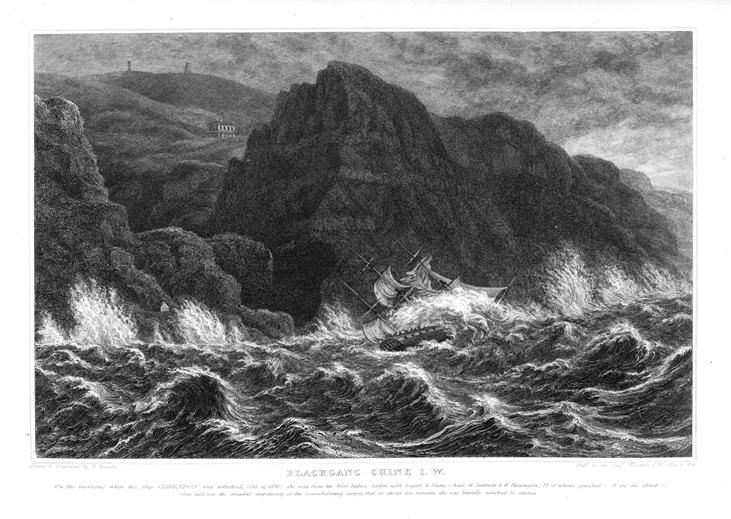
The Country between Blackgang and Freshwater.
ST. CATHARlNE's HILL, in the sea-cliffs of which is Blackgang Chine, is the highest land in the island, being nearly .900 feet above the sea-level: and affords “a prospect infinitely rich and almost unbounded.” Besides the Light-house (noticed at p.46,) and adjoining signal-station, there is a slender tower of an octangular form, part of a small chapel which was built on the site of a hermitage in the year 1323, at the expense of one Walter de Godyton, who assigned certain rents for the maintenance of a chantry priest to sing mass. and to provide lights as a beacon to ships driving near this dangerous coast. By day it is of essential use to vessels navigating the channel, and is therefore kept in repair.
Under the brow of the northern extremity
of the down is a small seat called THE MEDINA HERMITAGE, distinguished by a noble
column 72 feet high : its situation is very elevated, and commands a rich display
of the country from Niton to
In commemoration
of the. visit of his Imperial Majesty Alexander I, Emperor of all the
CHALE is a straggling village under the western flank of St. Catharine's Hill, known to the public more on account of its proximity to Blackgang Chine, than for any attractive feature of its own. The Parsonage and the Abbey-Farm-House are the principal buildings.—The Church is a plain structure of the age of Henry I, having a handsome square tower. The greatest part of the unfortunate persons who perished in the wreck of the ship Clarendon are buried here : their friends have erected tomb-stones to their memories, bearing inscriptions stating their particular names, the date of the catastrophe, &c., and there are few strangers who can pass by without feeling an interest and sympathy in the inspection of these mournful records.
From Chale the nearest road to Freshwater keeps within about a mile of the cliffs, passing thro' Brixton; but by making a trifling deviation on our right we may embrace the hamlet of KINGSTON, whose little Church stands upon an eminence surrounded by elms: and two miles further on we enter....
SHORWELL, a sweetly-sheltered village about five miles S.W. of Newport. The Church is a pleasing object, and the cottages have a pretty rural appearance—clean and profusely adorned with roses or other flowering shrubs ; but its essential charm is derived from the noble groves of....
NORTHCOURT, which is the finest old mansion in the island, being of the age of James I, 'and built with a species of free-stone of a light warm tint, procured near the spot. A steep hill rises immediately behind, shrouded in tall forest trees, with ever- greens and flowering shrubs intermingled ; while on the north extends an undulating lawn, shaded by an ancient avenue and scattered groups of majestic elms. There are several very tasty architectural appendages dispersed through the grounds, particularly a dairy, and a mausoleum enriched by a variety of well-written inscriptions.——Indeed every feature of the place is beautiful and picturesque; though much less so than formerly, in consequence of the house having undergone a thorough repairing both inside and out; a circumstance which will be for some time too apparent in the marks of the mason's trowel: and especially as it was found necessary to remove the luxuriant ivy that so richly manded its lofty grey walls and pinnacles, and which gave an uncommonly venerable aspect to the whole building.
BRIXTON (or, as it is commonly pronounced, BRISON,) is a considerable village two miles from Shorwell, situated at the foot of a lofty down, with an open aspect to the sea, from which it is distant about a mile; its ancient Church is spacious and respect- able for a country edifice : many of the cottages are extremely neat, some of them let for lodgings : and there is a decent country inn.
MOTT1STONE is a mile and a half further : it is a pretty hamlet, enjoying a sheltered situation under the high down rising upon the north, and appears before we enter it to be beautifully embosomed in wood. On an elevated part of the farm are the remains of some small druidical temple called Longstone, which is a rude piece of rock of a quadrangular figure, evidently erected by art, and rears itself about twelve feet above the ground : near it another large stone lies partly buried in the earth, of not less than eight feet long.
BROOKE is the next village we pass through, of a very pleasing rural character, being seated in a recess between two lofty downs. The Manor-house is well surrounded with wood, and the parish-church occupies a conspicuous situation, on a gentle eminence a little without the village.
o
The distance from St. Catharine's Hill to Freshwater is about 13 miles. With the exception of Shorwell and Northcourt, the first part of this tract presents nothing very interesting in its scenery. The traveller however cannot fail to admire the exuberant fertility of the lands, which being finely sheltered by a mountainous range of downs on the north, enjoy an uninterrupted exposure to the sun. The fields in general are large and well fenced-in : but unlike most other parts of the island, with scarcely any timber left standing in the hedge-rows. The agriculturist however considers this deficiency of sylvan honors amply compensated in the increase and proud display of his corn-ricks, and a perpetual supply of the finest water. “If this part of the country possesses few picturesque charms, it possesses what are better, the riches of soil and cultivation in a high degree.”
“Here Ceres'gifts in waving prospect stand,
And nodding, tempt the
joyful reaper's hand."
The road from Brooke winds over
Shalcombe, Compton, and Afton Downs, from whose lofty summits the traveller
will gain such extended prospects, as cannot fail to .afford him the highest
gratification : particularly of the expansive ocean, and the celebrated white cliffs of Freshwater.
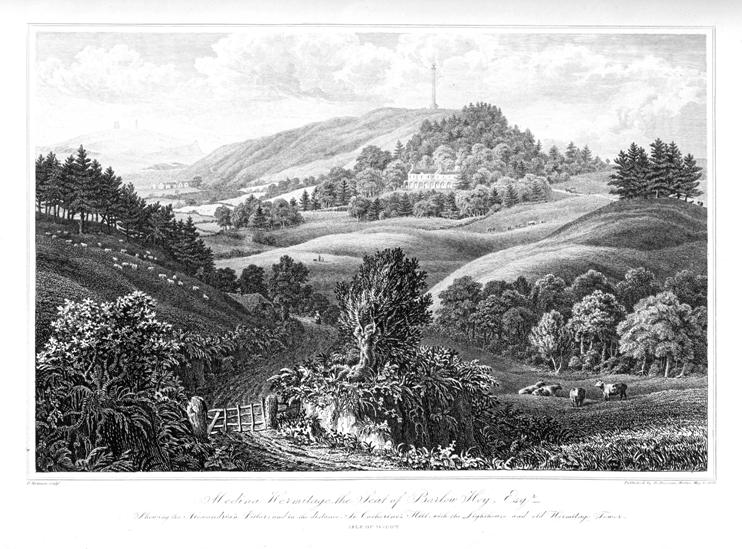
It has been already noticed, how frequently
accidents occur on this coast to vessels in foggy or tempestuous weather. The
SPHYNX, of 1050 tons, considered the finest steam-sloop in the British navy in
point of construction and engine equipments, ran ashore on the reef off Brooke,
between five and six in the morning of January 16, 1847. The whole of the night .and morning was
excessively foggy; but there was fortunately no wind to endanger the ship, had
every due precaution been adopted. As the shore here is nearly flat for above
half a mile seaward (mostly indurated clay), she was in a moment firmly fixed
at a short distance from the cliffs: guns and the more ponderous stores were
thrown 6verboard, masts cut away, &c., but all to no purpose. At low tide
she lay nearly dry; which happily afforded every facility for communicating
with the shore. There were above 300
persons on board, who were all saved; but of a boat's crew sent from another
ship, seven were drowned in the breakers.
Several steam-vessels from
o
THE FRESHWATER CLIFFS,
Forming the western boundary of the
island, are universally allowed to display as magnificent and beautiful scenery
as any part of the English coast. Being
generally approached by the road over the downs from Brooke, we shall commence
our description at FRESHWATER-GATE ; where a low, narrow bank of shingly
pebbles, thrown up by the furious waves, interposes between the briny element
and the spring-head of the river YAR, which circumstance is supposed to have
given the inappropriate name of “Freshwater”
to this part of the island: it takes a northerly direction, communicating with
the Solent Channel at Yarmouth: and of course, if ever the present slight
barrier should be removed, this quarter will then be completely insulated, as
is said to have been the case some centuries back. Here are situated two
respectable hotels: Plumbly's, and
the
The BAY is distinguished on the east side by two very remarkable isolated rocks (the nearest being of a conical form and the other a bold, irregular arch), winch have long defied the united assaults of the stormy winds and waves, and firmly maintained their original position, while the parent cliff has been gradually washed away by the tides, and is now removed back at least fifty or sixty yards. Beyond these huge masses of rock the coast is seen in perspective as far as St. Catharine's Hill, which forms a beautiful termination to the view.
Excepting the romantic scenery of the Undercliff, we know of no part of the island more interesting to the geologist, or the attentive observer of Nature's operations, or which can afford more delightful subjects for the pencil of amateur sketchers, than are to be found in Freshwater Bay: it abounds with striking objects: the bold and well-defined outline of the chalky cliffs, the several deep caverns and immense isolated rocks (especially those called the Arched, and the Deer-pound), have all such a picturesque character, and lie within so short a distance of each other, that they may be delineated either singly or in composition, with facility and a good effect. The beach too is uncommonly pleasant, being an interchange of loose shingles or firm sand, and scattered weed-covered rocks; which contribute greatly to swell the musical murmurs of the restless waters. In fine sunny weather the whole scene is at once splendid and amusing : but under the lurid aspect of a raging storm, it is then sublimely interesting :—
"While eddying whirl, and breaking wave,
Rous'd by the blast of winter, rave,
Through sparkling spray in thundering clash,
The lightnings of the waters flash
In awful whiteness on the shore,
That shines and shakes beneath the roar."
On the west side of the bay is a natural CAVERN in the impending cliff, penetrating the rock about 120 feet: but its recesses are occasionally closed by an accumulation of shingles washed in by the waves, and rocky fragments detached from the roof:—its interior formerly exhibited a highly romantic and picturesque appearance, as the principal' opening was a bold rugged arch of about ten yards wide and of nearly the same height; but in the winter of 1842, the arch and a great portion of the cliff above unexpectedly fell in with a dreadful crash; when happily no person was near at the awful moment.
WATCOMBE BAY, to which there is now a very convenient descent, partakes much of the same scenic character as Freshwater Bay, of which it may be considered a portion or continuation: it is particularly remarkable for a very picturesque and curious pyramidical rock; and numerous romantic caves of considerable depth, communicating with one another by perforations worn through the chalk by the violence of the rushing tides. Many other chasms and deep caverns are also found along this beautiful range of cliffs, the most noted being called Neptune's, the Bar, Frenchman's Hole, Lord Holmes's Parlour and Kitchen, and the Needles Cave.
From Freshwater-gate the chalky
precipices extend about three miles, rearing them- selves in a gradual progress
of elevation to a wonderful height,—in two particular parfa called Mainbench
and High-down, to at least six hundred
feet above the sea-level (being, we believe, nearly one-third higher than
any other chalk cliffs in
A carriage-road leads from
Freshwater-gate up to the LIGHT-HOUSE, which is a gratifying object of
curiosity to persons unacquainted with the nature of such an estab- lishment :
it stands near the extremity of the down, and commands a prospect of great
extent and beauty, particularly of the unrivaled scenery of
The Needles are seen to most advantage from off the water; but when this has not been enjoyed, a party should here approach within a few yards of the precipice, “and to those whose nerves are proof against the horrors of the position, the view into the bays beneath, and of the cliffs and Needle Rocks, is extremely sublime. The agitation and sound of the wave? below are hardly perceived, and it is scarcely possible to imagine that the quiet expanse which now seems stretched in boundless repose under the eye, is the same turbulent element which had but lately been seen bursting in clouds of foam, and thundering on its rocky shore. In hard blowing weather, the fury of the wind on this promontory is scarcely credible.—Very large flints and fragments of chalk are blown from the cliffs, so as to endanger the windows of the light-house, and for many days in succession it is scarcely possible to open the door:” yet even here the light-keepers have brought up large families of children, “who, with the fearless agility of goats, explore the cliffs by paths hardly visible, and make it their daily amusement to descend by the perilous aid of ropes, in search of sea-birds' eggs.”
It is astonishing, and to many parties really painful, to see with what cool indifference the men of the light-house and preventive station stand with the spy-glass lifted to the eye, or supinely repose, on the very brink of the precipice, —and not unfrequently lean over the dreadful abyss, apparently much beyond their balance: and yet it would appear from experience that all this is practised by them without jeopardy,—for the fatal accidents which have occurred were owing to a dark and foggy state of the weather. The unfortunate light-keeper about the year 1830 was precipitated over the cliff in returning home between eight and nine in the evening, during a dense fog (leaving a large family); and two or three years afterwards the assistant shared the same unhappy fate.
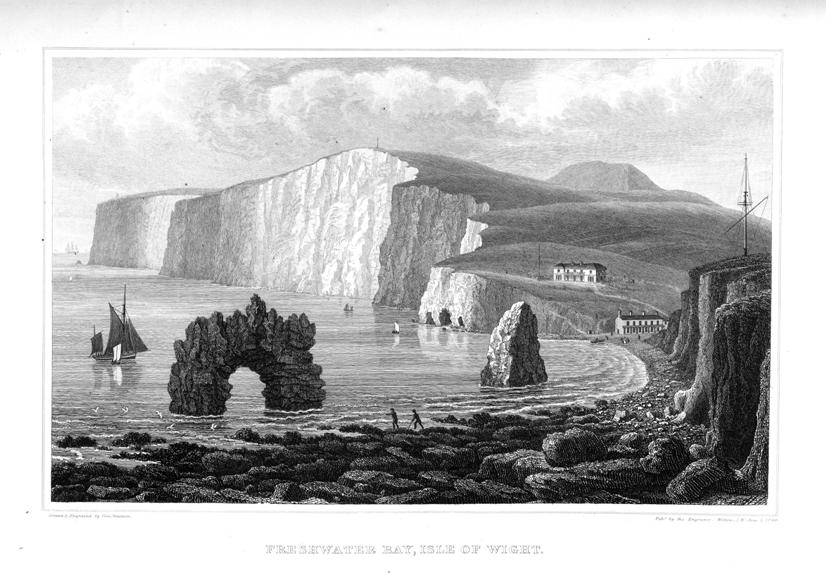
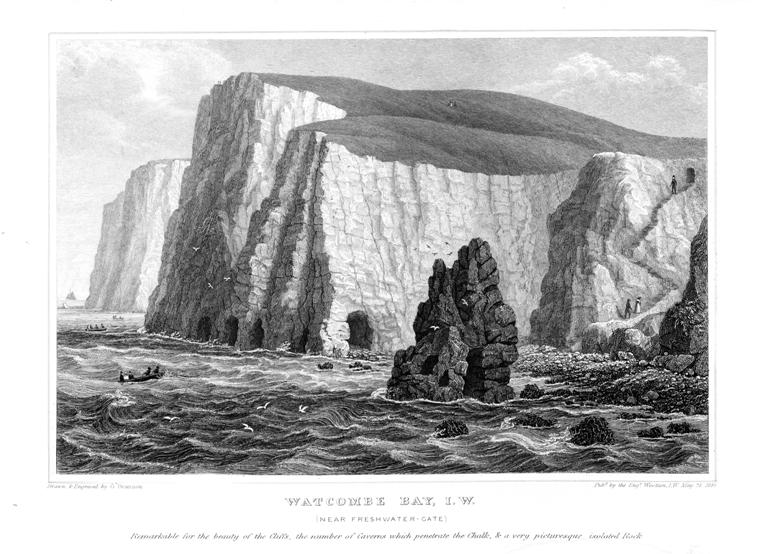
THE NEEDLE ROCKS
Are seen at the termination of this
noble promontory, rearing their craggy heads most majestically above the waves
: they are the remains of the original cliff, "which they serve to
continue in idea beyond the present boundary, and give an awful impression of the
stormy ages that have gradually devoured its enormous mass." Their forms bear no resemblance whatever to
their name, which was derived from a spiry rock about 120 feet high, that fell
in the year 1764 with so tremendous a crash, as to have been heard at the distance
of several miles; indeed it is said by some, that the shock was felt as far
even as
"Nothing can be more interesting,
particularly with those who take pleasure in aquatic excursions, than to sail between
and round the Needles. The
wonderfully-colored cliffs of Alum Bay,—the lofty and towering chalk precipices
of Scratchell's Bay (which is nearly the termination of the promontory), of the
most dazzling whiteness and elegant forms;—the magnitude and singularity of
those spiry insulated masses, the Needle Rocks, which seem at every instant to
be shifting their position, and give a mazy perplexity to the place;—the
screaming noise of aquatic birds;— the agitation of the sea, and the rapidity
of the tide, occasioning not unfrequently a degree of danger...all these
circumstances combine to raise in the mind unusual emotions, and to give the
scenery a character highly singular and romantic. Scarcely a winter passes without one or more
shipwrecks in this place, many vessels choosing to risk this shorter passage to
and from
“The Needles, which from the island appear
much less striking, proved on approaching them to be rocks of great magnitude.
My visit to them happened at an interesting juncture, June 12, 1811,—when the
Pomone, a frigate of 50 guns, returning home after an absence of three years,
had but the day before, struck on the point of the most western Needle. The chalk rocks having pierced through the
bottom of the ship, she remained immovable, and soon became a complete wreck.
The crew and passengers, among whom were some Persian princes, fortunately got
safe on shore. The vessel afforded me a scale by which to judge of the size of
the Needles, and I was surprised to find that the hull of the frigate did not
reach one-fourth of their height. The
view of the end of the Isle of Wight from the Needles, at any time is one of
the most uncommon, and at the same time, one of the most magnificent scenes in
To the east of the Needles is SCRATCHELL'S BAY, whose towering precipices are very remarkable for the beautiful exhibition of their flint-defined stratification. Here , aquatic parties generally land to enjoy the refreshment of a walk on the beach; and if the local boatmen be engaged, they will particularly point out a coved Recess in the cliffs, which presents to the spectator (when his back is placed against the concave chalk,) an ARCH of such stupendous dimensions as at once to impress the soul with astonishment and ecstatic admiration: for it is scarcely possible for any work of art to be more true in the magnificent sweep which it takes: nor can any scene be more brilliant than that viewed from beneath its awful roof. Scenery at all times improves upon the eye when relieved by the contrast of some near and bold overshadowing object: but how heightened—how indescribably grand must be the effect of viewing such a truly sublime picture as is here presented, from under the ample shade of an arch which is full two hundred feet high ! and overhangs the beach at least one hundred and eighty.
Scratchell's Bay is the termination of the Freshwater Cliffs, or promontory on which the Light-house is seated ; the Bay is formed by the line of the Needle Rocks on the west, and on the east by a bluff called SUN CORNER, near which is the " Grand Arch." Except when the sun is shining full on this part of the scene, which is from about eleven till two o'clock, little idea of its existence would be formed by a person looking at it from a vessel sailing by;—and no stranger, even when approaching it at the favorable time, would ever imagine that it possessed "such an astonishing grandeur of effect as it does if viewed from under it-3 tremendous shade; but when thus seen, it will be allowed to be of itself worth the visit to Freshwater; and it is unaccountable how so important a feature should so long have escaped the notice of the local guides and historians—for this Work was the first that introduced it to public attention.
Another neglected object well worth attention in sailing under these lofty precipices is the WEDGE-ROCK, most appropriately so called from the very extraordinary circumstance of a large piece of chalk about six feet wide, by ten or twelve feet long, and precisely the shape of a wedge, being fixed between the parent cliff and an immense pyramidical rock, exactly as if placed there by some gigantic hand to effect a separation. To the curious visitor who has sufficient agility to clamber over the formidable craggy rocks, which are here thrown about in a most romantic manner, it will prove highly interesting to penetrate the fissure between the pyramid and main cliff, not only from the examination of this very singular result of accident, but from the bold and picturesque character of this particular portion of the range: it is situated near the towering precipices of High-down, on which the beacon is erected.
o
The Freshwater Cliffs are frequented at periodical seasons by such prodigious flights of sea-fowl of various kinds, as can be "described only by the hyperbolical expression of darkening the air. They sit commonly, when they are not in motion, on the ledges of the cliffs—in the crannies of which they breed. You see them ranged in black files for a considerable space. The report of a gun brings them all out of their recesses ; and the air, which a moment before was still and quiet, is now beaten with myriads of busy wings, and filled with screams and cries as various as the tribes from which they issue."——" We have often rested on our oars under the rocks," says another celebrated writer, "attentive to the sounds above our heads, which, mixed with the solemn roar of the waves swelling into and retiring from the vast caverns beneath, produced a fine effect. The sharp note of the sea-gull, the loud screams of the auk, together with the hoarse, deep, periodical croak of the cormorant, which serves as a bass to the rest, often furnished us with a concert, and, joined with the wild scenery around us, afforded us a high degree of pleasure."
The birds are taken by the country-people at the hazard of their lives: they descend by means of a stout rope which turns round a crow-bar firmly fixed in the ground above; one end of the rope being fastened about their body, and the other end held in their hands, by which they lower and raise themselves from ledge to ledge of the horrid precipice.——The aquatic fowl furnish most amusing sport to numberless shooting-parties during the season. The .principal species are...puffins, gulls, cormorants, Cornish choughs, the eider-duck, auks, divers, guillemots, razor-bills, widgeons, willocks, daws, starlings, and pigeons. Their breeding-season is in the months of May, June, and July; and towards the end of August the greatest part of them migrate with their new generations,, Their flesh is too rank and fishy to be eaten, and is used only for baiting crab and lobster pots : the feathers are valuable; and the eggs are 'bought chiefly by visitors for their curiosity.
l
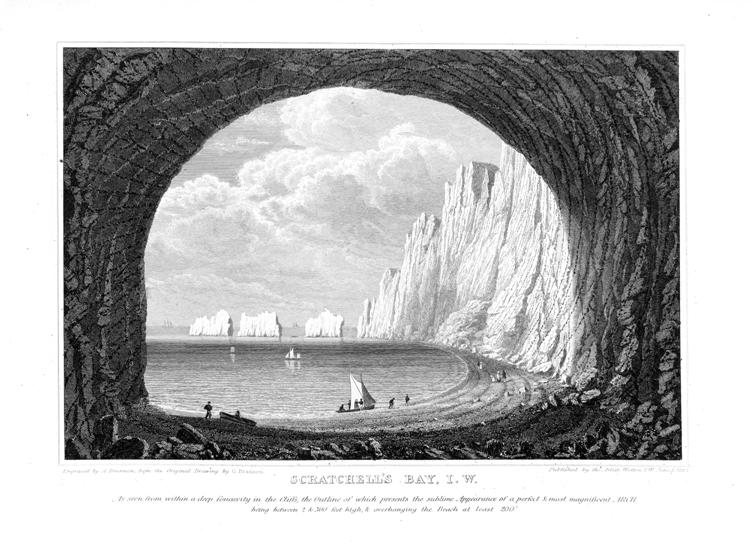
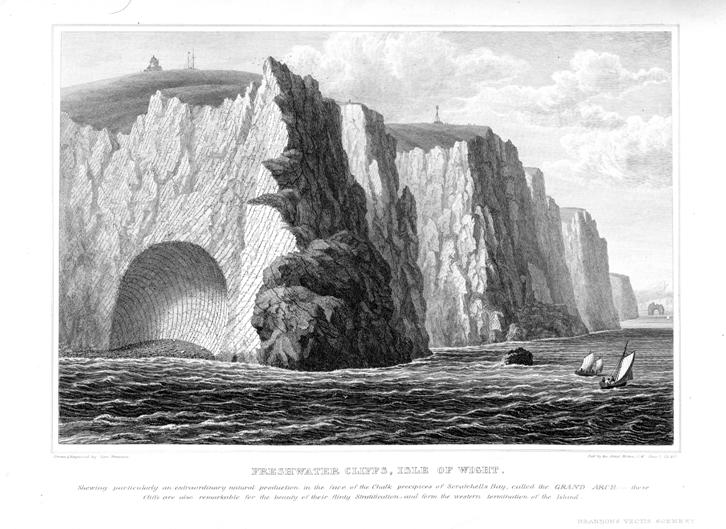
Situated on the north side of the
promontory, is so named from that mineral being frequently picked up on the
shores : but its celebrity is owing to a most beautiful and unique feature in
the sea-cliffs. For about a quarter of a mile from the Needles Point, the cliff
is one vast precipice of chalk, from the glare of which there is a sudden
transition to a very extraordinary exhibition-of various COLORED sands, clay,
and ochreous earths, dis- posed in alternate vertical strata .-—white, black,
red, blue, and yellow, blending into every variety of tint; and so vivid are
the colors, that they have not unfrequently been compared to "the stripes
on the leaves of a tulip," and to "the stripes of silk."——There
is a Hotel near
ln proof how well this portion of the coast
merits all the eulogies which we have before quoted from various writers, we
shall add the unbiassed testimony of a foreign gentleman. Mr. RUSH, the American Ambassador to the
Court of
“In good time we
approached the Needles. The spectacle
was grand. Our officers gazed with admiration. The very men, who swarmed upon
the deck, made a pause to look upon the giddy height. The most exact steerage seemed necessary to
save the ship from the sharp rocks that compress the waters into the narrow
strait below. But she passed easily
through. There is something imposing in
entering
o
THE ROAD FROM
Leaving these grand and impressive
scenes, we shall now shape our course through the parish of Freshwater to the
town of
The lands about Freshwater are extremely fertile, and well interspersed with nourishing wood: the village itself consists of many straggling cottages. The Church is a large heavy building, but still in its general outline is a pleasing object.
From the more elevated grounds, we shall be
presented in the course of our progress with a most enchanting panoramic
prospect of this quarter of the island, and of the opposite coast. This renders a ride to Yarmouth or Norton
very agreeable, although there is no individual object possessed of striking
interest in either direction, except the RIVER YAR—when seen at the favorable
moment of high water: this most engaging feature winds beautifully between
gently arising banks feathered with grove and copse, embosomed in which is here
a mansion and there a cottage: while its course is marked by vessels,
pleasure-boats, and a considerable number of swans, seen gliding and sporting
on its silver bosom. But at its junction with the Solent Channel, the river
forms a busy picture of maritime life: the sea-port town of
" Like constellations in the starry sky."
h
THE BOROUGH OF
Stands at the mouth of the river Yar, opposite Lymington, and was once a place of con- siderable importance, for it was the first town in the island that obtained a charter of franchises in the reign of Henry II: and until the time of the passing of the Reform Bill returned two members to parliament: although there are no more than about 100 houses, mostly occupied by pilots and sea-faring people. It is very clean and open, and being situated in the neighbourhood of the most interesting coast scenery, is upon the whole an agreeable place, particularly for gentlemen partial to aquatic pleasures. Its chief support is derived from the shipping that anchor in its excellent roadsted, and the passengers to and from Lymington: there are three inns—the principal one (the George) being a large ancient building, formerly the Governor's house, where king Charles II was entertained on his paying the island a visit.——The Church has recently received the ornament of a new tower, and is otherwise much improved in its appearance; the interior boasts a good statue of Sir Robert Holmes, who was governor of the island in the year 1667. The Castle (as it is called,) is a heavy, plain mass of building, constructed in the reign of Henry VIII to protect this entrance to the Solent Channel.
The
On quitting Yarmouth, we pass a large
genteel residence enveloped in a thick plantation, and presently the road
divides: the left-hand branch running
to Newport and Cowes through the village of SHALFLEET:—from which is situated
about a mile to the north, the ancient borough of NEWTOWN, which like Yarmouth,
has lost nearly all its original importance; for in the reign of Richard II it
was a very populous place, though now reduced to about nine or ten humble
cottages, and therefore has been deprived of its unmerited privilege of sending
two members to Parliament.
☞The reader having now been conducted round THE COAST of the island, so distinguished for its variety and grandeur of scenery : it remains to lead him through THE INTERIOR : here he will find the landscapes of a soft and beautiful character—sublimity having but little share in their composition.